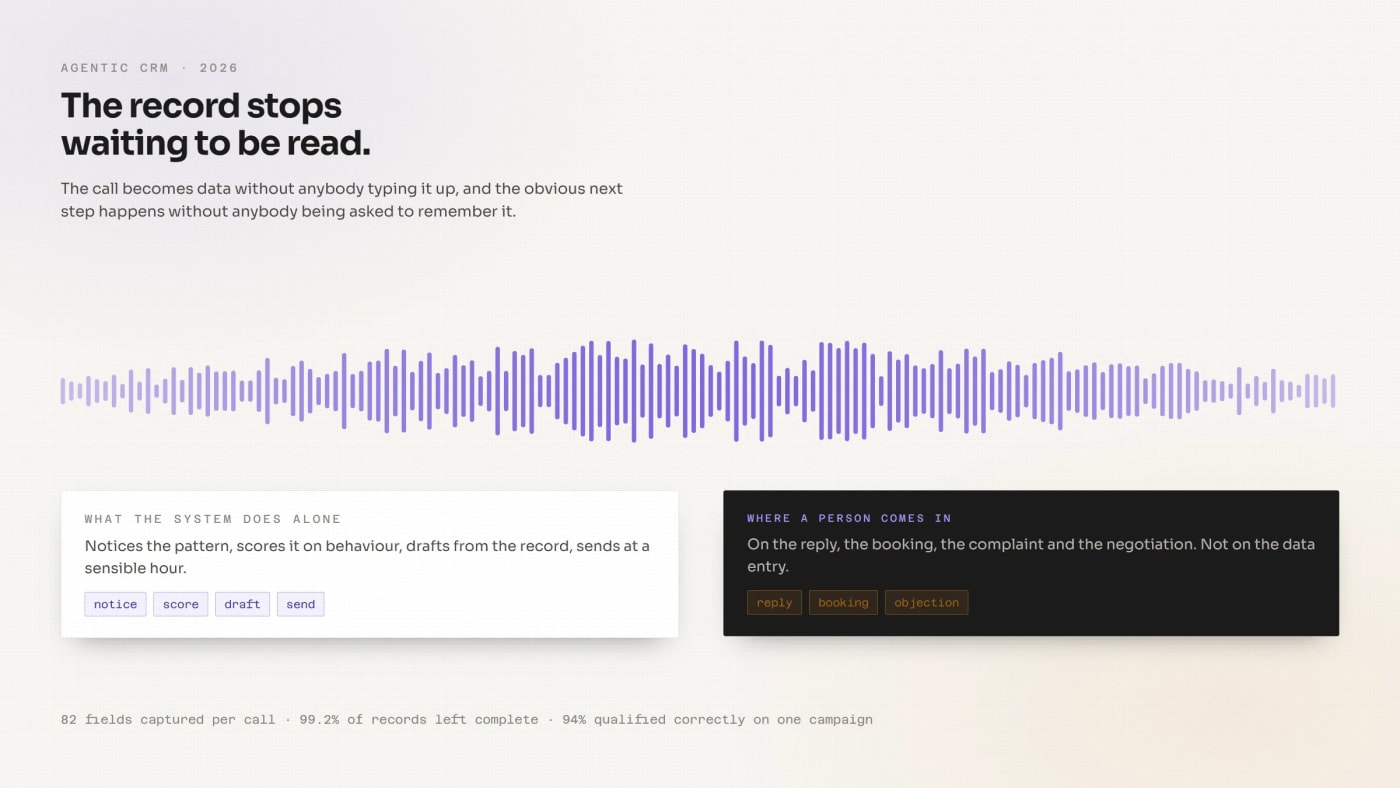
A CRM has always been a system of record. Something happens, somebody writes it down, and the record waits to be read. The change worth paying attention to is that the record can now start the next thing by itself, and that the conversation which produced it no longer has to be typed up by the person who had it.
That is two separate shifts, and they arrive together. One is an agent acting on a deal. The other is the call becoming data. We covered the broader parts of CRM automation in a separate piece; this one is about those two, because they are the ones that change what the job feels like.
As before, the percentages circulating on this topic, the 41% productivity lift, the 20 to 35% conversion increase, the 60% faster response, come from vendor material we could not trace to a study. The numbers below are from systems we built.
What an Agent Actually Does on One Lead
The standard example is worth walking through because it shows where the risk sits. A prospect visits your pricing page three times in a week and opens the last email twice without replying. An agentic CRM can:
- Notice the pattern rather than waiting for somebody to spot it in a report.
- Raise the lead's score on the behaviour, not on the job title in the record.
- Draft a follow-up that refers to what the person actually looked at.
- Send it at the hour that has historically worked for that time zone.
- Tell the rep only when there is a reply or a booking, instead of adding a task nobody clears.
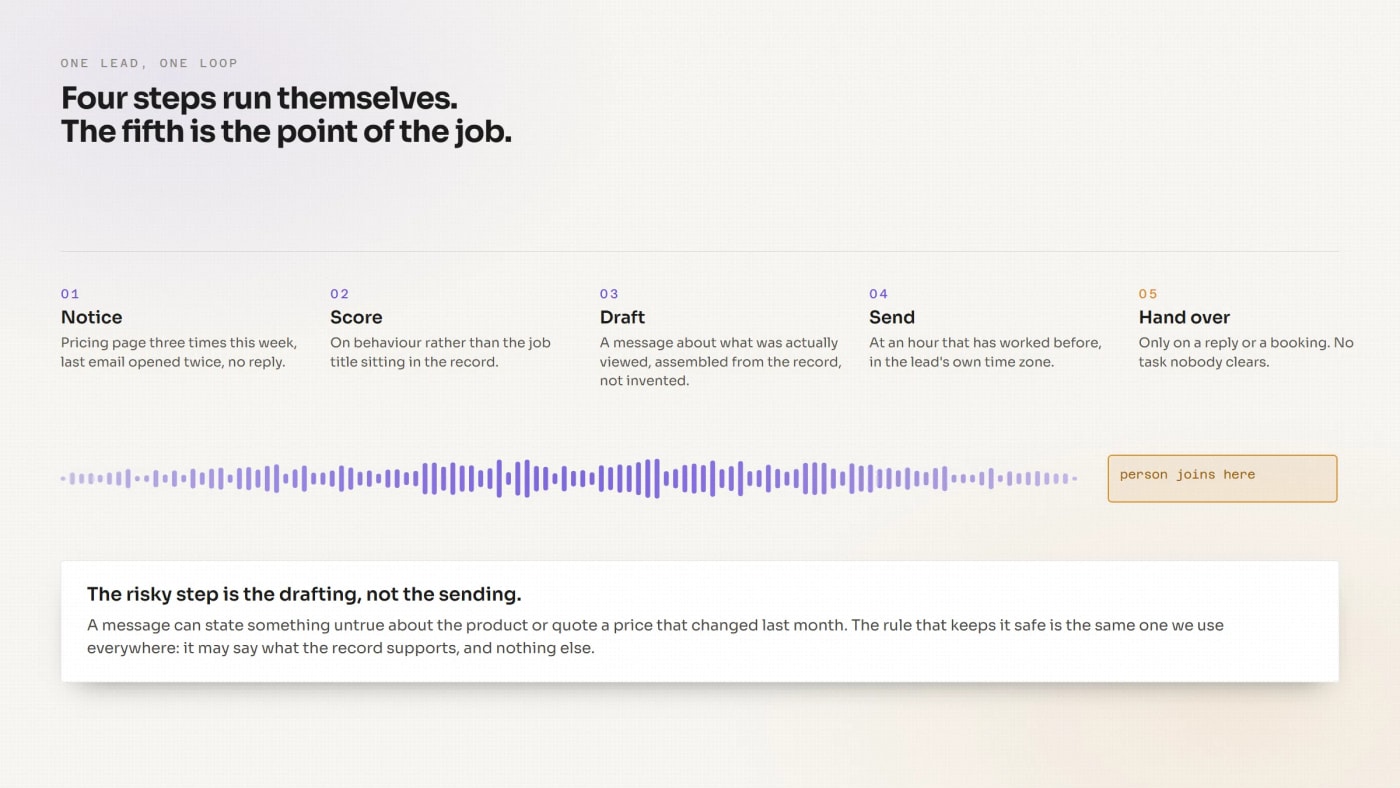
Four of those five steps are safe to run unattended. The one that is not is the drafting, because it is the step that can say something untrue about your product or quote a price that no longer exists. The guardrail is the same one that applies everywhere else: the message is assembled from the record, not from the model's memory, and anything it cannot support it does not claim.
Our own booking flow is the smaller, fully automatic version of this loop. It acts on the request end to end without a person in the path, and the one thing it will not do is tell somebody a booking exists when the calendar write failed.
The Conversation Is the Data
Every business already has the richest source of customer intelligence it will ever own, and throws most of it away. People say exactly what they want, what is blocking them and what they are comparing you against, and then somebody types three lines of notes afterwards, if there is time.
Our voice agents treat that differently. The call is both the service and the capture.
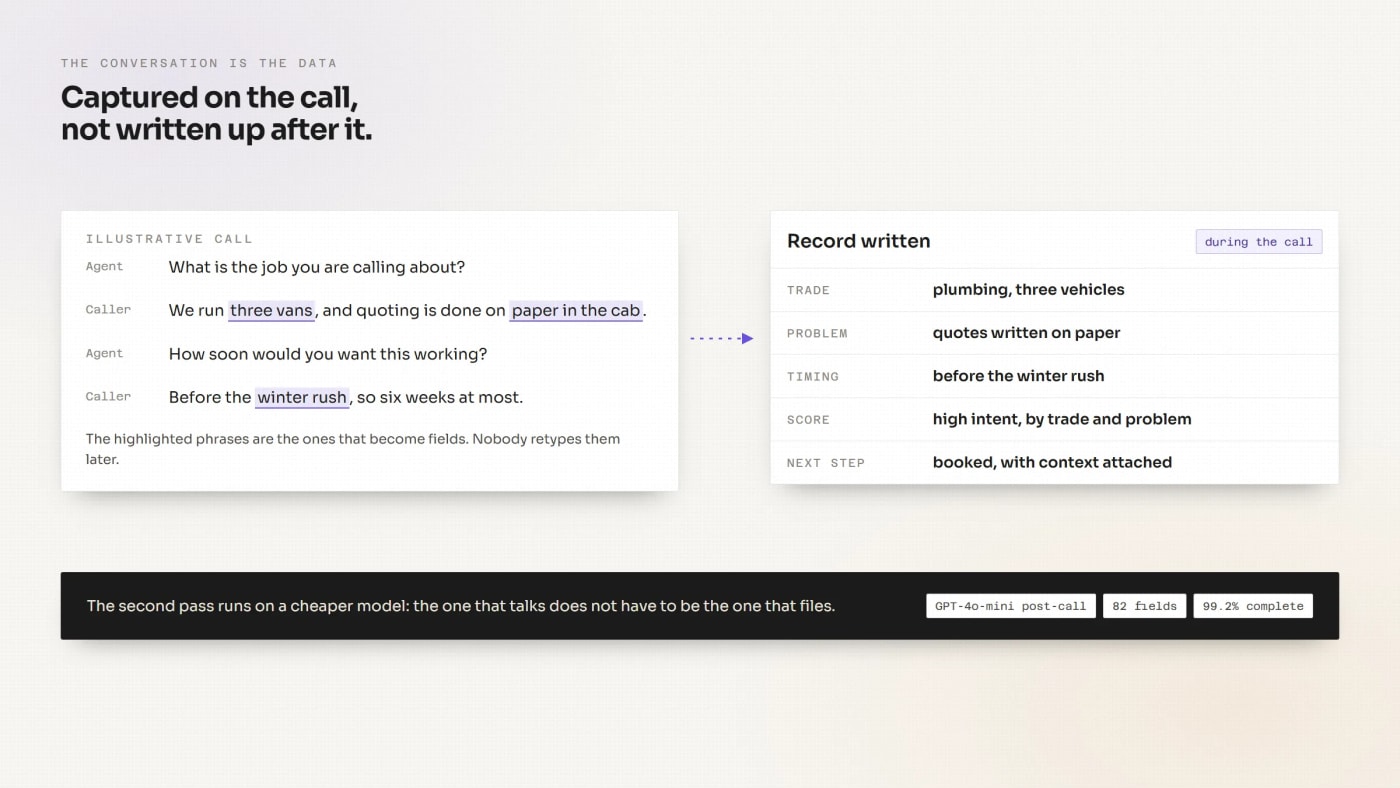
- Structured capture during the call. The tax practice receptionist fills in 82 separate fields while the line is open. Not a summary written later: individual fields, confirmed with the person who can correct them.
- A cheaper model for the second pass. The restaurant and pet care agents run GPT-4o-mini over the finished call for analysis. The model that talks does not have to be the model that files.
- Qualification from answers, not inference. The outbound agent put one question to each business about its current bottleneck and scored what came back. Across a campaign of more than 500 calls, 94% landed in the right bucket.
- Complete records as a measurable target. 99.2% of customer records left complete, because completeness was treated as a feature rather than a hope.
What that unlocks is the part people call conversational intelligence: summaries and action items that already exist, objections visible across calls rather than in one person's memory, and a handover that carries what the caller said rather than a fresh start. We wrote up how those agents are built in the piece on voice agents.
The Signals Worth Acting On
Scoring gets all the attention on the way in. The same machinery is more valuable on the way out, because keeping a customer is cheaper than replacing one and the warning signs are usually visible weeks early.
- Use that tails off. Logins thinning, a feature that used to be daily now weekly, a seat that stopped being filled.
- Support traffic that changes shape. Not just more tickets, but tickets about the same thing twice.
- Silence after a renewal date appears on the horizon. The absence of contact is a signal, and it is the one CRMs are worst at noticing.
- Intent on the way in. Pricing revisited, a quote opened repeatedly, a case study shared internally. In our field-service platform the equivalent is a quote sitting unaccepted, which triggers reminders on a schedule the business sets rather than on somebody's memory.
None of this works on CRM fields alone. It needs product events, support history and billing in the same place, which is the unglamorous integration work that decides whether any of the clever parts function.
Personalisation That Does Not Make People Uncomfortable
Generated messaging per lead is now trivial to produce and easy to get wrong. The two failure modes are opposite and equally damaging: a message so generic it announces itself as automated, or one so specific it tells the recipient how closely they have been watched.
The rule we work to is that the message may reference what the person told you, or what they did in your product, and nothing else. A follow-up that says you asked about three-vehicle cover is useful. One that says you looked at the pricing page at 11:40pm is not.
Channel matters as much as wording. Some customers answer WhatsApp and ignore email entirely, which is why our agents treat the channel as part of the record rather than a company-wide default.
Doing It Without the Project Collapsing
- One painful process first. Lead response or follow-up, usually. Prove it, measure it, then widen. A programme that starts with a platform migration rarely reaches the interesting part.
- Clean before you connect. Duplicates and empty fields become duplicated sequences and confused scores the moment automation touches them.
- Baseline the numbers beforehand. Response time, share of leads handled without a person, record completeness. Without a before, every after is an opinion.
- Favour systems with real APIs. The integration layer is where this work actually lives, and we keep it outside the CRM so changing it is not a migration. Our comparison of the automation platforms is here.
- Show the team how the scoring works. A score nobody can explain is a score nobody uses, and the project dies quietly rather than loudly.
Where This Goes Next
Four directions look reasonable from where we sit, stated as direction rather than prophecy. Updating a deal by talking to the CRM instead of typing into it, since the transcription and extraction already work. Low-value, high-volume deals handled start to finish without a person, in the way bookings already are. Customer intelligence that joins CRM records to product usage, support and billing rather than guessing from one of them. And personalisation that works from what the customer told you, as privacy rules keep narrowing what else is available.
The thread running through all four is that the CRM stops being where work gets reported and becomes where it gets done. Scoping this sort of build is covered in our guide to agents in a business.
Questions We Get on This
What does an agentic setup cost?
It is priced by integrations and risk, not by features. Reading from two systems and writing to one is a short build. Letting software send messages on your behalf means adding review, limits and logging, and that is where the hours go. Platform AI add-ons cost whatever the vendor charges; the custom part costs what the plumbing costs.
Will this replace the sales team?
It replaces the data entry, the dialling and the chasing. Nobody has ever won a complicated deal because the CRM was tidy, but plenty have been lost because a follow-up never happened.
How long does it take?
Switching on a platform's built-in AI is days. A custom agent that qualifies, writes and hands over is weeks, and most of those weeks are integration and testing rather than model work.
What data do we need before starting?
Contacts you trust, interaction history, and pipeline stages that reflect reality. Historical outcomes matter most for scoring, because a model learns from what closed and what did not. If the stages are decorative, fix that first.
Can it work with the calls we already take?
Yes, and that is often the cheapest starting point. Transcription and structured extraction on existing calls produce usable records without changing how anybody sells.
Start With the Conversation You Are Already Having
The fastest return in this whole category is not a new model. It is capturing properly what your team already hears every day, and letting the system act on the obvious cases while a person handles the rest.
Want help picking the first one? Book a 30-minute call, and the AI automation and AI agents page lays out what the work covers. We have been putting agents on live phone lines and into live pipelines since 2020, and our Upwork feedback averages 4.99.
One for the comments: what does your team currently write down after a call, and what gets lost?

Building AI-Powered SaaS Products, Mobile Apps & Business Automation | Trusted by Clients in 20+ Countries
Comments
No comments yet. Be the first to share your thoughts.
Leave a comment