A phone that rings out is a quiet kind of loss. Nobody logs it, nobody follows it up, and the caller books somewhere else. Most businesses have no idea how many of these they have in a week.
That is the gap voice agents close first. Not the clever conversation, not the demo that sounds human. Just answering, every time, and writing down what was said.
What an AI Voice Agent Actually Is
A voice agent listens, understands plain speech, and acts. The difference from the phone menus everyone has suffered through is that it does not make the caller navigate anything. The caller says what they want and the agent does it.
The part that matters is the acting. An agent that answers questions is a help page read aloud. An agent that checks the live calendar, holds the slot, writes the customer record and sends the confirmation has done the job the receptionist would have done.
On a real line that work splits into six jobs, and most businesses want the first three long before they care about the rest.
- Answers every inbound call, at any hour, with nobody on hold.
- Qualifies the caller in plain conversation instead of a form.
- Books, moves or cancels an appointment against the live calendar.
- Answers the three or four questions that make up most of the call volume.
- Hands the call to a person when it should, with the context attached.
- Calls out for follow-ups, reminders and lists nobody had time to work through.
What the Numbers Actually Say
Grand View Research puts the AI voice agents market at $2.54 billion in 2025, reaching $35.24 billion by 2033, a 39% compound rate across 2026 to 2033.
The same report splits that market the way clients actually ask for it. Inbound agents took 52.1% of 2025 revenue, and customer support automation was the largest application of the year. Answering the phone is still the job people want solved first.
Salesforce's service research found 66% of customer service organisations now using agentic AI, up from 39% a year earlier. Gartner expects 40% of enterprise applications to include task-specific AI agents by the end of 2026, up from under 5% in 2025.
One number worth handling carefully: the widely quoted $80 billion saving in contact centre labour is from a Gartner forecast made in 2022 about 2026. It is a projection, not a measurement, and it is four years old.
We checked a dozen other figures doing the rounds, on ROI percentages, adoption rates and cost savings, and dropped them. Nearly all of them trace back to vendor blogs quoting each other rather than to a study anyone can read. The numbers below are ours, from systems we built and ran.
Booking: The Phone That Always Answers
Restaurants, clinics, salons and groomers lose money the same way. The phone rings during service and nobody can reach it.
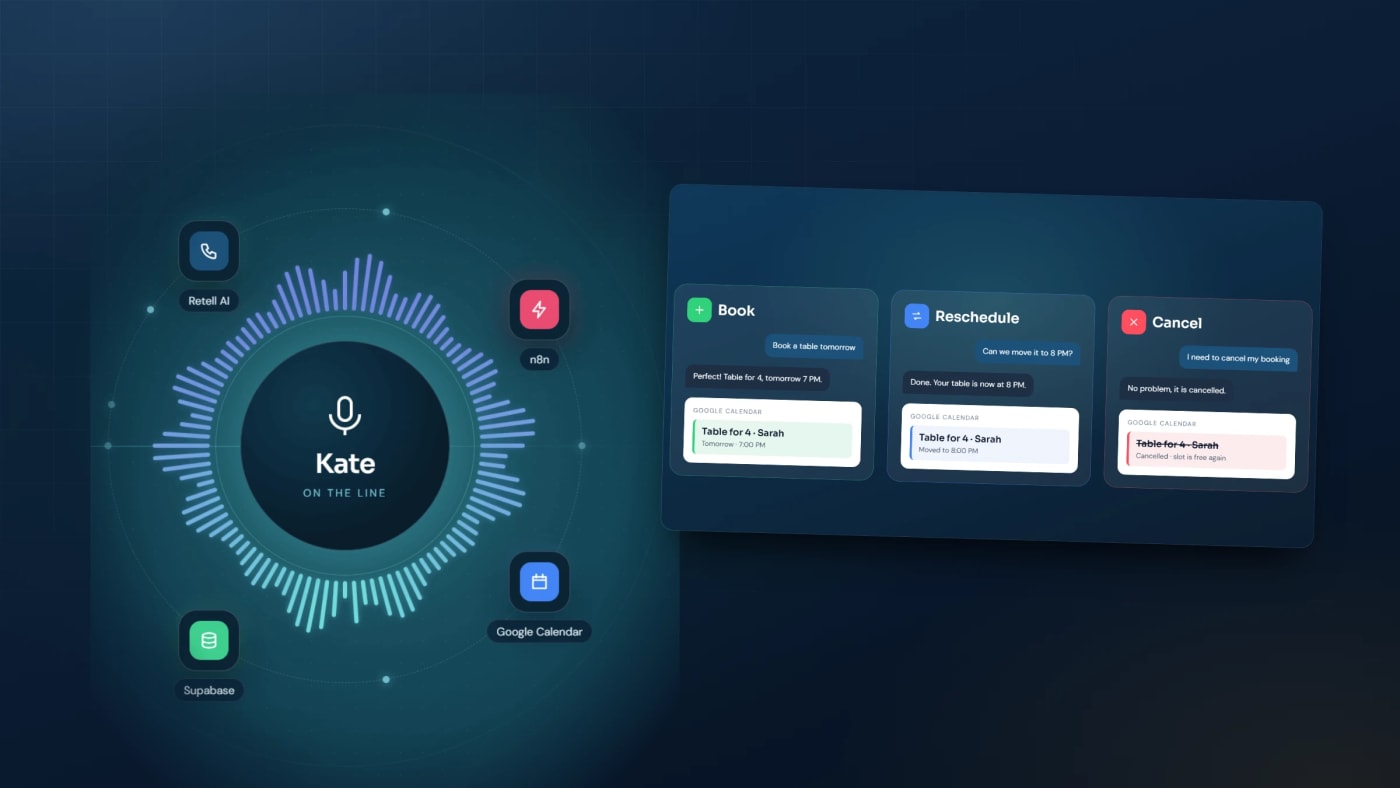
Our restaurant reservation voice agent answers every inbound call, checks the live calendar before it confirms anything, and writes the booking into Google Calendar and a customer database. Its figures: 100% of calls handled, 99.2% of customer records complete, 90% less admin time, and zero double bookings, because availability is verified before a slot is given away.
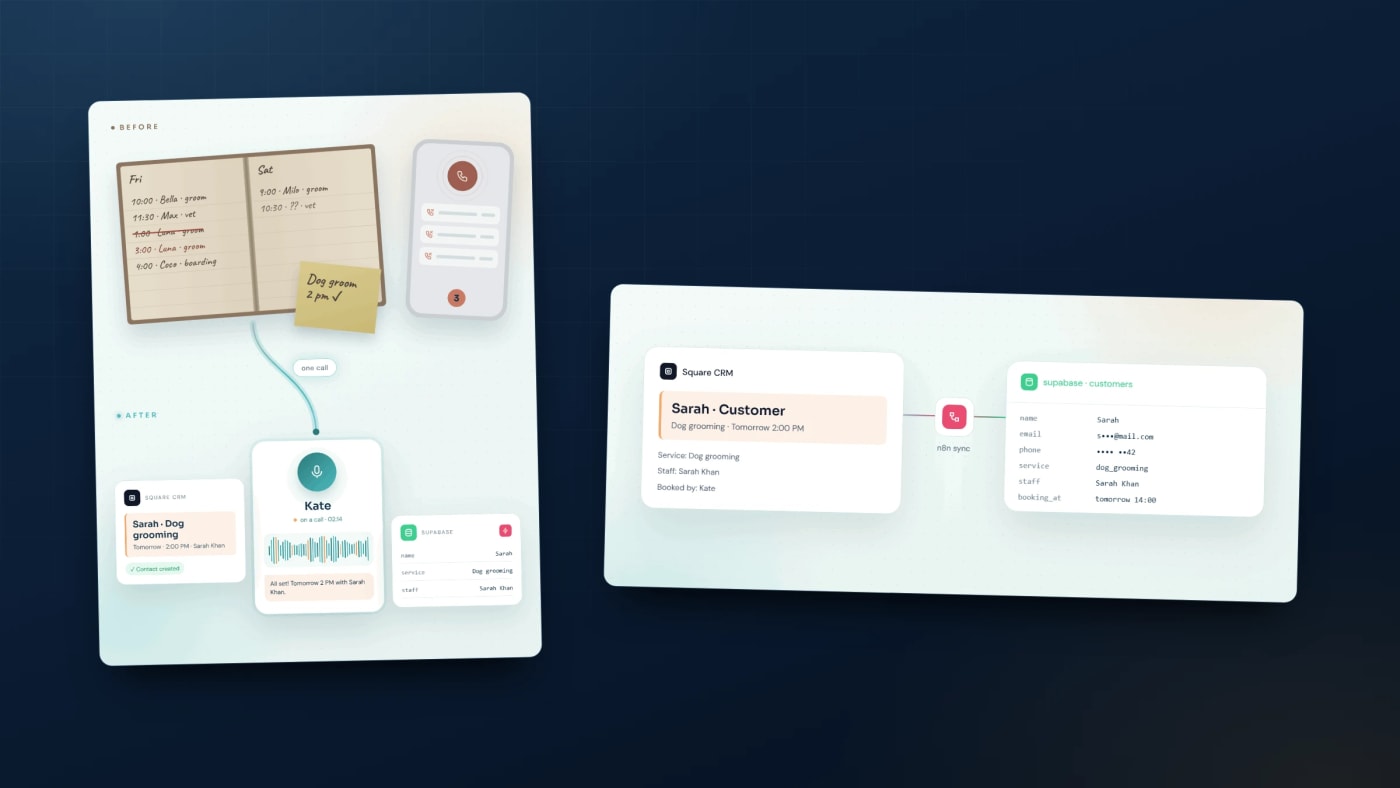
The pet care booking agent does the same work for grooming, vet and boarding appointments, with one extra problem to solve: it has to pick the right staff member as well as the right slot. Every booking lands in Square CRM and Supabase with nobody re-typing it.
Outbound: The List Nobody Had Time to Call
Most businesses have a list like this. Leads from an event six months ago, gone cold because following them up by hand never reached the top of anyone's day.
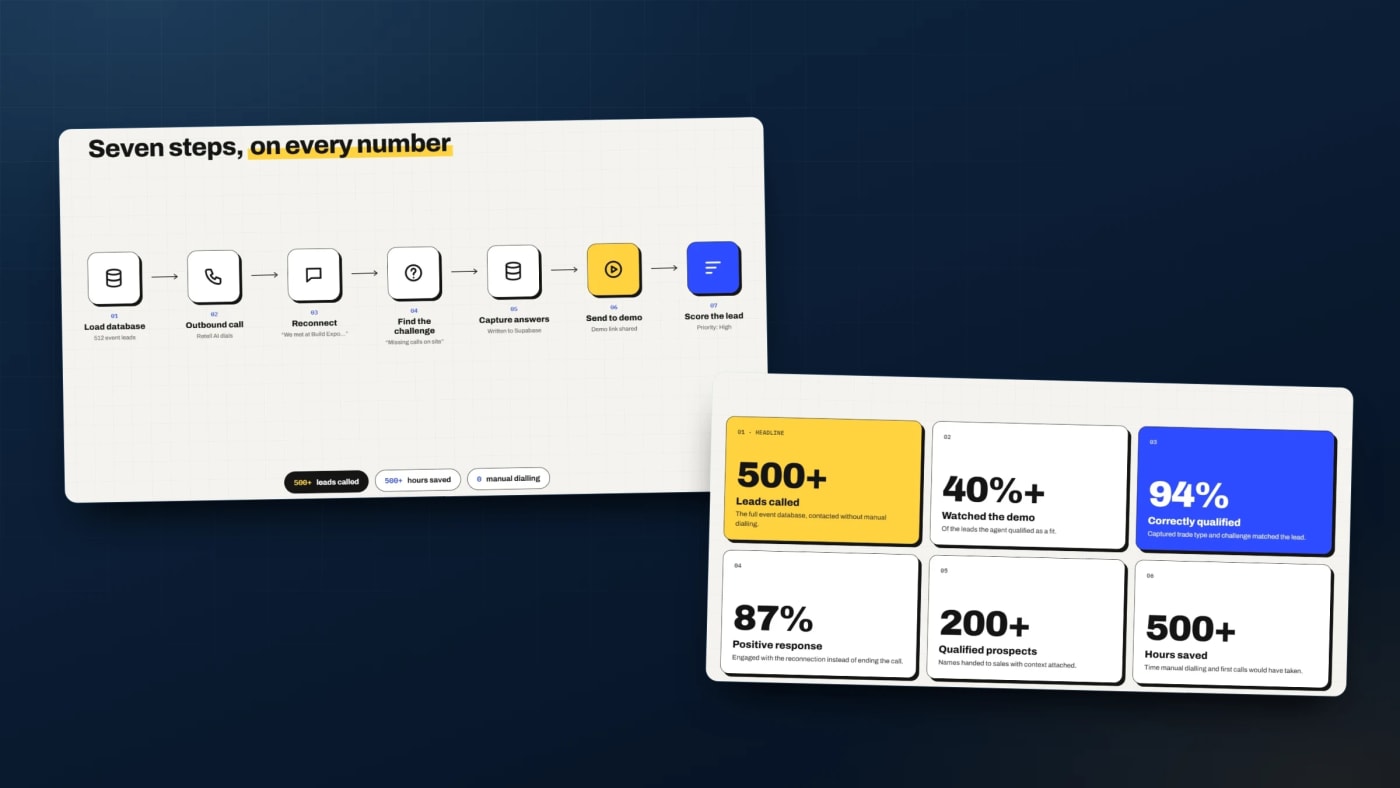
We pointed an outbound agent at one. It called more than 500 dormant event leads, opened with the event they came from, asked what each business was struggling with, and sent the interested ones to a demo.
- 500+ leads called, with no manual dialling
- 87% engaged with the reconnection rather than ending the call
- 94% correctly qualified by trade type and challenge
- 40%+ of the qualified leads watched the demo
- 200+ qualified prospects handed to sales with context attached
- 500+ hours saved against dialling the same list by hand
Reception: Three Lines, One Practice
The hardest voice work we have done is not a restaurant. It is a phone receptionist for a one person tax practice. Three agents answer three campaign lines. The caller is recognised before the phone is picked up. The agent works out how much time is left on an IRS notice and books a real calendar slot during the call.
It captures 82 fields per call and triages 10 types of IRS notice, and it cut the operations needed per call by 63%. For a practice of one, that is the difference between taking the call and losing it.
What a Voice Agent Is Actually Made Of
Six pieces, and only one of them is the model. It is worth knowing the parts, because the price and the quality both come from how they are wired rather than from the conversation itself.
- Telephony. The line itself. The tax practice runs on Twilio SIP trunking with A2P 10DLC registration, so the same agent that answers a call can also send a compliant text.
- The voice platform. Retell AI runs the call on all four of ours: speech in, turn taking, interruptions, and the webhooks that let the agent act in the middle of a sentence.
- The reasoning model. GPT-5 handles dialogue on the booking agents and GPT-4.1 on the outbound one. GPT-4o-mini does the post-call analysis afterwards, which is a cheaper job than talking and does not need the same model.
- The voice itself. 11Labs, with a voice chosen per client rather than a default. Both booking agents use the same one, Cimo, because it suited the businesses.
- The automation layer. n8n on three of them, Make.com on the tax practice. This is where a finished call turns into a calendar event, a CRM contact and a database row.
- The systems of record. Google Calendar, Square CRM, Folk CRM, Calendly and Supabase across the four. An agent is only as useful as the systems it is allowed to write to.
There is a version of this with no cloud speech at all. Butler AI, inside our field-service platform, runs Sherpa-ONNX on the device so no audio leaves the phone, and searches previous quotes with pgvector before drafting a new one. Same idea, a much tighter privacy budget.
The part we spend most of our time on is none of the above. It is the wiring: the CRM you already run, GoHighLevel or otherwise, SMS in the same flow as the call, and retrieval over your own records so the answers come from your documents rather than the model's memory.
Latency Is the Experience
What makes an agent feel like software is not the voice. It is the pause. Every extra hundred milliseconds before the first word is dead air the caller fills with doubt, and anything past about half a second reads as a bad line.
On the tax practice we had a contractual budget of one second for the lookup that runs before the phone is even answered. The live CRM round trip measured 789 ms at the median and 1,440 ms at worst, so it did not fit. The lookup moved into a small FastAPI service holding the contact store in memory: 26 ms from cold and effectively instant when warm, with the CRM left behind the same interface on a 400 ms timeout as the fallback. A benchmark settled that, not a preference.
None of this shows up in a demo. It is the difference between a caller who stays on the line and one who hangs up before the greeting finishes.
What Separates a Working Agent From a Demo
Every voice agent sounds good in a demo. The demo is three minutes long and the person running it knows what to say. Real callers talk over the agent, change their mind, and ask things nobody scripted.
- It is tested like software, not like a chatbot. The tax receptionist carries 447 automated tests, 87 acceptance scenarios and 151 spoken lines under test. That is what stops a change to one line breaking a different call.
- It checks before it promises. Zero double bookings is not a clever model. It is the agent reading the live calendar before it confirms.
- It knows who is calling before it answers. The pre-call lookup on the tax line returns in 26 ms from cold, so the greeting already knows the caller.
- It writes everything down. 99.2% complete records is the number that decides whether the call was worth taking.
- It hands over cleanly. When a call is beyond the agent, the person who picks it up needs the context, not a fresh start.
- It works in the caller's language. Butler AI covers all four Swiss languages, English, German, French and Italian, in one build. A second language should not mean a second agent.
- It respects what the call contains. A tax notice, a medical history or a card number changes what you may store and where it is allowed to travel. On-device speech, retention limits and a clean escalation path are decisions made at the start, not settings found later.
Where This Is Going
Voice is the visible edge of a wider shift. UiPath's 2026 trends survey has 78% of executives saying they will need to reinvent their operating models to get the value out of AI agents, which is a polite way of saying the software now does the step instead of presenting it to somebody who does.
On a phone line that is already the case. None of the agents above read answers out. They check a calendar, create a contact, score a lead, send a text, book a slot and leave a transcript behind. The call is the interface and the work happens underneath it. For the same shift away from the phone, there is our guide to putting an agent into a business.
How to Put One In
- Start with the call you lose most often. Usually booking, rescheduling or the same three questions. High volume, low judgement.
- Decide what it is allowed to do. Reading a calendar is one level of trust. Writing to it is another. Taking payment is another again.
- Wire it into what you already run. A booking that does not reach your calendar and your customer record has not happened. This is the work, and it is where n8n, Make and GoHighLevel earn their place.
- Run it on a slice of calls first. Measure how many it finishes without a human, then widen it.
More on how we build these on our AI automation and AI agents page. For the same shift inside software rather than on the phone, there is our piece on AI-driven SaaS.
What Clients Ask Before the First Call Goes Live
Will callers know it is not a person?
Some will, and that is fine. What people object to is being stuck, not being answered by software. An agent that books the table in forty seconds beats a hold queue every time.
What happens when it cannot handle the call?
It hands over. The point is that the handover carries everything the caller already said, so they do not repeat themselves. An agent that cannot escalate cleanly is worse than no agent.
How long does it take to put one in?
A single booking flow on one line is a short build. The time goes into the integrations and the testing, not the conversation. The tax receptionist took 447 automated tests to be trusted on three lines.
Which phone system does it need?
It sits alongside what you have rather than replacing it. Most connect over SIP trunking or a provider like Twilio, as ours do, with A2P 10DLC registration where the agent sends texts as well. The agent takes the call types you give it and everything else routes exactly as it does today.
What does one cost to build?
There is no single number, and anyone quoting you one before asking about your integrations is guessing. The conversation is the cheap part. Cost sits in how many systems the agent writes to, how many call types it has to get right, and how much testing it needs before you trust it on a live line. One booking flow into a calendar is a short build. The tax receptionist, with three lines, 82 captured fields per call and 447 automated tests, is a different order of work.
Which businesses get the most out of it?
Anywhere the phone rings more often than somebody can reach it and most of those calls look alike: restaurants, clinics, salons, groomers, trades and small professional practices. Outbound suits anyone sitting on a list nobody has time to work through. Healthcare and finance can work too, but the compliance questions come before the call flow, which is why our own healthcare AI work so far is Medd AI, a content platform rather than a phone line.
Count the Calls You Miss
Count the calls you miss for one week. Not the ones you handled badly, the ones nobody picked up. That number is the business case, and it is usually larger than anyone expects.
If you want to work through it, we run free 30-minute consultations. Across 103 reviews on Upwork our average job feedback is 4.99, and we have been building since 2020.
One for the comments: how many calls do you think your business missed last week, and would you want to know the real number?

Building AI-Powered SaaS Products, Mobile Apps & Business Automation | Trusted by Clients in 20+ Countries
Comments
No comments yet. Be the first to share your thoughts.
Leave a comment