The question has changed. Two years ago buyers asked whether a product had AI in it. Now they ask what the product does on its own while nobody is watching.
That is the whole shift, and it is not about bolting a chat box onto an existing tool. It is about software that notices something has happened and finishes the job.
From AI-Augmented to AI-Native
An AI-augmented product has an assistant somewhere in it. An AI-native product is organised around the work the AI does: the screen you land on, the thing that happens when a lead arrives, the report that writes itself on Friday.
The difference shows up in the roadmap. In an augmented product, the AI is a feature with an owner. In a native one, removing the AI would leave you with no product at all.
What the Numbers Actually Say
Gartner expects that 40% of enterprise applications will include task-specific AI agents by the end of 2026, up from under 5% in 2025.
That is a forecast rather than a measurement, and it is worth more than the adoption percentages doing the rounds, most of which trace back to vendor blogs quoting one another. The direction is the point: agents are moving from demo to default.
Five Shifts Reshaping SaaS
1. Agentic AI: software that acts
An agent owns an outcome across more than one system. It reads the request, checks what is true right now, writes the record, and tells someone. The work that used to pass through three inboxes happens in one pass.
2. Vertical SaaS beats generic tools
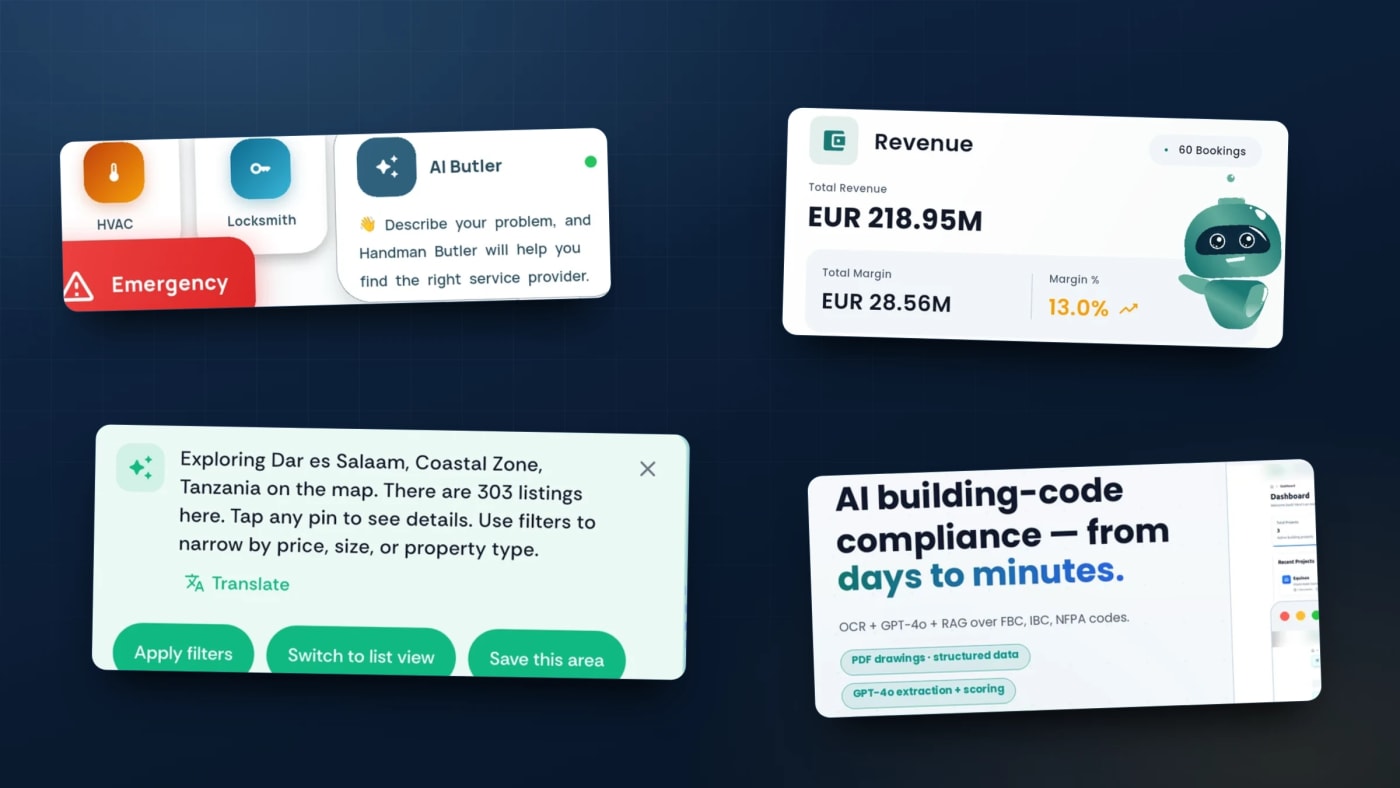
A platform for Swiss tradespeople does not resemble one for African tour operators, and neither resembles a permit-review tool for Florida engineers. All four of the products below are vertical, and that is not a coincidence. The narrower the trade, the more the AI can assume.
3. Automation replacing manual workflows
This is the least glamorous shift and the one that pays first. Data entry, document handling, scheduling, follow-up. It is also the easiest to measure, because the work either still lands on someone's desk or it does not.
4. Pricing that follows the outcome
Per seat pricing assumes people do the work. When the software does it, the seat count stops describing the value, and pricing drifts towards what was produced rather than who logged in.
5. API-first and composable
Our travel platform runs a React web app, a Flutter mobile app and an AI chat interface against one FastAPI and PostgreSQL backend. Build the backend first and every surface after it is cheap. Build the screens first and you pay for the mistake three times.
AI SaaS Products We Have Built
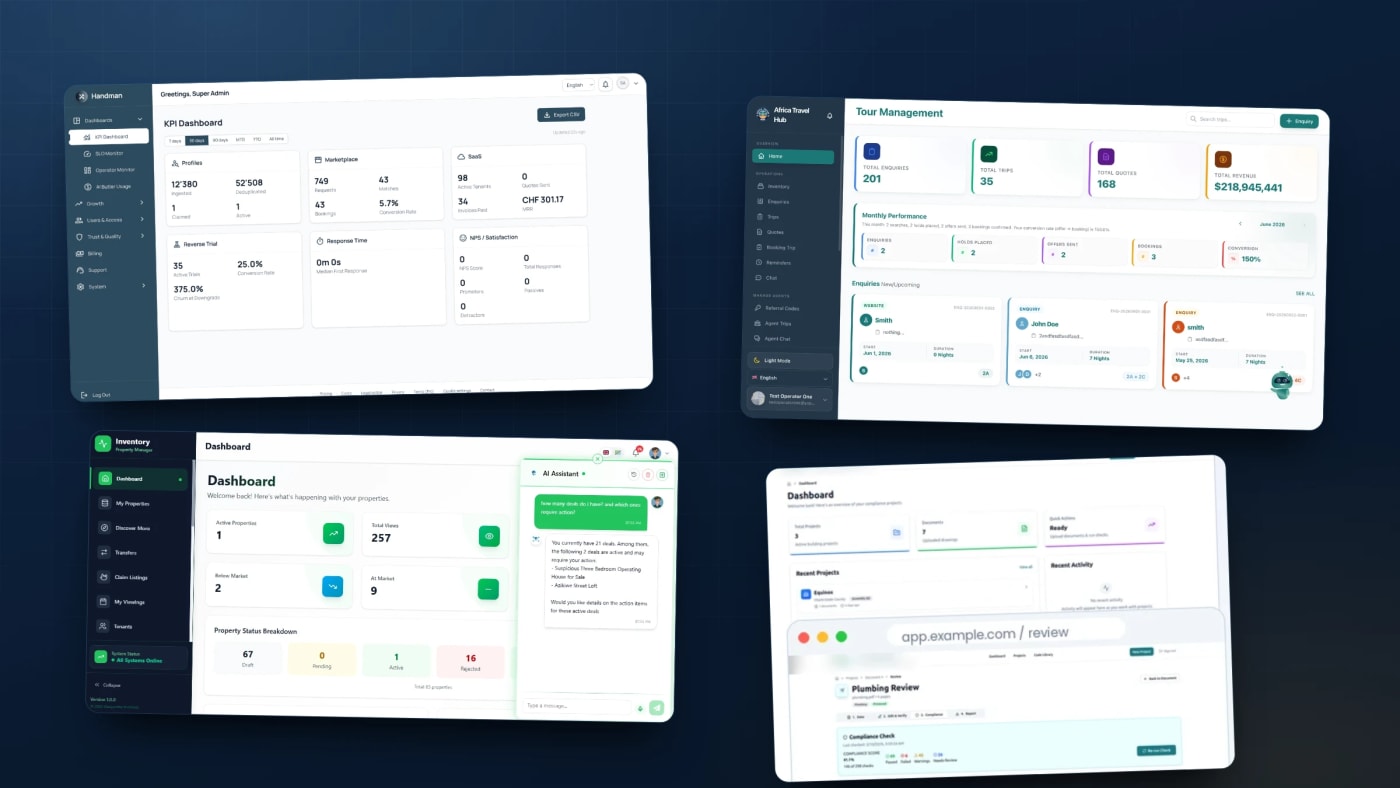
AI Field-Service SaaS is a Swiss contractor platform covering leads, quotes, jobs, billing, payments and dispatch. Its AI Butler reads a problem described in text or in a photograph and turns it into a quotation, which is the step that used to keep tradespeople at the kitchen table after dinner.
AI Travel-Operations SaaS replaces the spreadsheets, WhatsApp threads and disconnected tools African tour operators were running on. A Butler AI co-pilot carries the workflow from enquiry through to itinerary, and the same backend serves web, mobile and chat.
AI PropTech SaaS puts five roles, agents, buyers, tenants, lawyers and caretakers, on one Flutter codebase with one FastAPI backend. Buyers search live listings on a geo-map with AI area summaries; agents run deals through a nine-milestone deal room.
AI Building-Code Compliance SaaS reviews construction drawings against building codes, work that takes Florida engineering practices days per project. It cuts that to hours, and every finding it raises is grounded in a real code passage retrieved from the indexed FBC, IBC and NFPA standards. The AI cites, it does not guess.
What Automation Actually Returned
Two automations we run are worth quoting because they were measured rather than estimated.
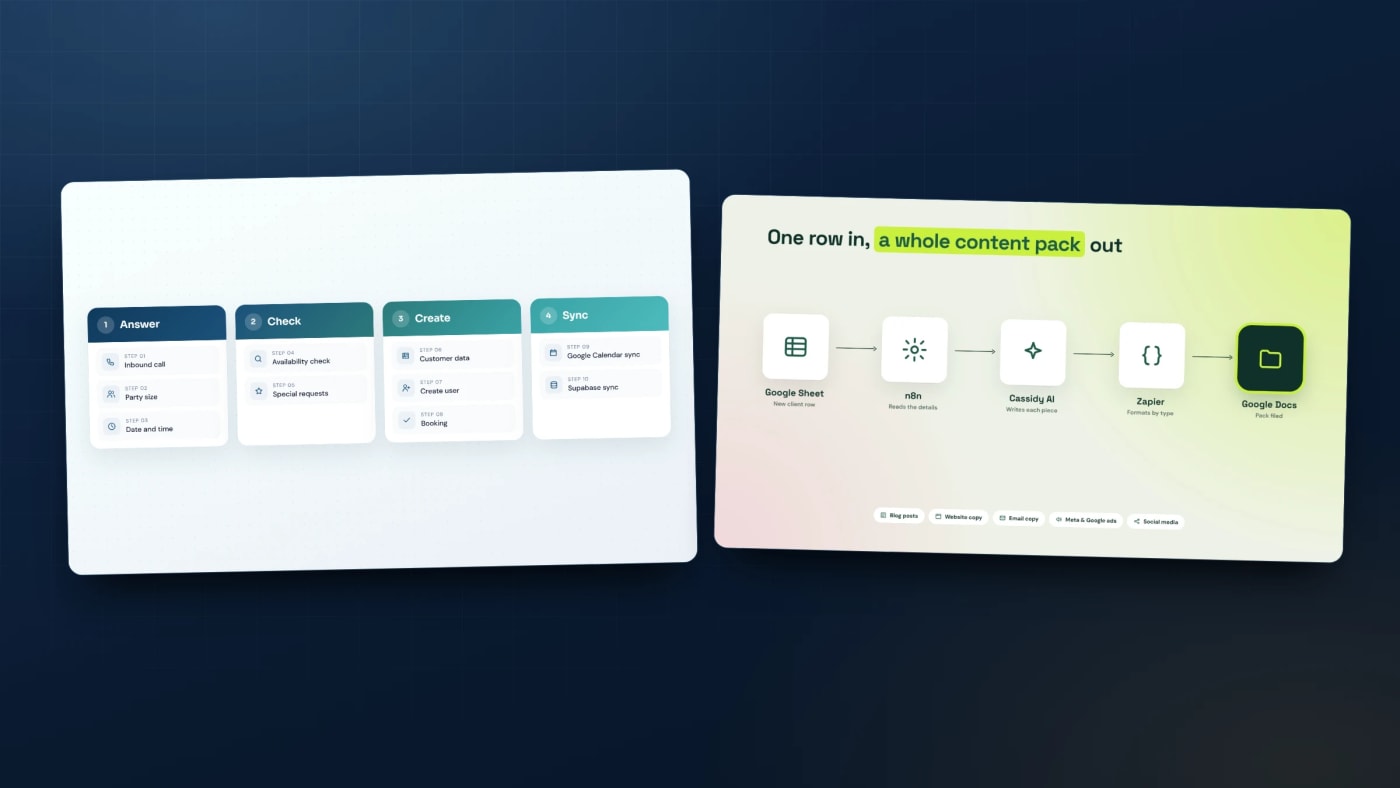
The restaurant reservation voice agent answers every inbound call, checks the live calendar before confirming, and writes the booking into Google Calendar and a customer database. Its figures: 100% of calls handled, 99.2% complete customer records, 90% less admin time, and zero double bookings, because availability is verified before a slot is given away.
The automated content generation pipeline watches a Google Sheet. A new client row sets off n8n, which runs the business details through Cassidy AI for blogs, website copy, emails, ad copy and social posts. Zapier formats each piece and files it in Google Docs. What used to be days of writing from a blank page arrives as an organised set of documents.
The Case for Building Your Own
- The market wants vertical, not general. Every product above sells because it speaks one trade's language. Generic tools are the ones being replaced.
- The build is shorter than people expect. Two of ours reached a working MVP in 60 days: Miploy for Canada's blue-collar job market, and Toolbox for a UK trade business.
- The backend is the asset. One API serving several front ends is what makes the second and third surface affordable.
- Recurring revenue compounds. A product with real retention is worth more than the same work billed once.
A Practical Roadmap
- Weeks 1 to 2, validate. Talk to people who have the problem. Quantify what it costs them now. Find some who would pay before you write code.
- Weeks 2 to 4, design the AI. Decide which capabilities are core, whether pre-built APIs will do, and where the data comes from. The data pipeline is the hard part, not the model.
- Weeks 4 to 12, build the MVP. One valuable AI feature, with authentication, multi-tenancy and billing in from the start, because retrofitting those costs more than building them.
- Week 12 onwards, launch and watch. Compare how people actually use the AI with how you assumed they would. That gap is the roadmap.
The stack we reach for: n8n or Make for workflows, voice agents for calls, GoHighLevel for CRM automation, and RAG-based assistants for support. More on how that fits together on our AI automation and AI agents page.
Questions People Ask Before They Start
Do we have to replace our current software?
Often not. Start with the workflow that leaks the most time and automate that against the systems you already run. Replacement becomes a decision you make later, with evidence.
How small can the first version be?
Small enough to run in 60 days. Both of our 60-day builds shipped with one job done properly rather than five done partly.
What makes an AI feature trustworthy?
Being checkable. The compliance platform cites the code passage behind every finding, which is why reviewers accept its output. If a user cannot see why the AI said something, they will not act on it.
Where to Start
Pick the process that costs you the most hours and the least thought. That is where an agent earns its keep, and it is usually also where the measurement is easy.
If you want to map it out, we run free 30-minute consultations, and our scalable SaaS solutions page covers how a build runs. For the mobile side of the same shift, there is our piece on AI-native mobile apps. Across 103 reviews on Upwork our average job feedback is 4.99, and we have been building since 2020.
One for the comments: which process in your business would you hand to an agent first, and what has stopped you so far?

Building AI-Powered SaaS Products, Mobile Apps & Business Automation | Trusted by Clients in 20+ Countries
Comments
No comments yet. Be the first to share your thoughts.
Leave a comment