Property is the most data-heavy industry that still runs on phone calls and PDF attachments. Prices, comparables, ownership records, lease histories, maintenance logs, all of it exists, most of it badly organised and rarely in the same place twice.
That gap is what PropTech is selling into, and it is why so much of what gets demonstrated never ships. The interesting work is not the valuation model. It is everything underneath it: the search that answers in under a second, the deal that keeps five parties in step, the message that sends on a 3G signal that drops.
A note on the numbers before we start. The figures doing the rounds on this subject, that adoption jumped from 20% to 58% in a year, that 92% have tried AI while 8% have automated anything, that AI users expect 31% portfolio growth against 12%, that agents save 5.4 hours a week, all trace to vendor reports or press summaries we could not verify at source. We have left them out. What follows is from a platform we built and run.
What a Real PropTech Build Contains
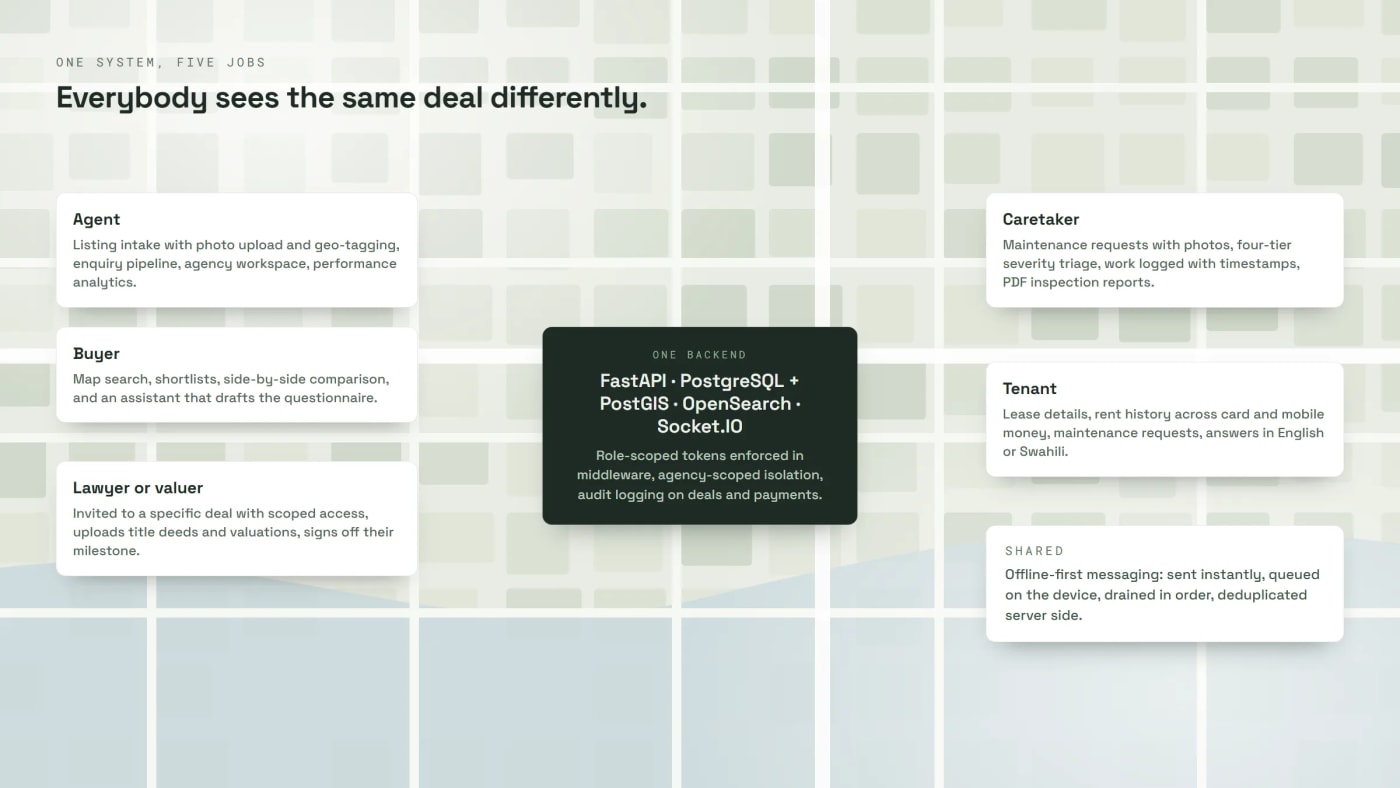
Our multi-role property platform serves agents, buyers, lawyers and valuers, caretakers and tenants from one backend, with a Flutter app for iOS, Android and web and a React console for agencies. The feature list reads nothing like a pitch deck.
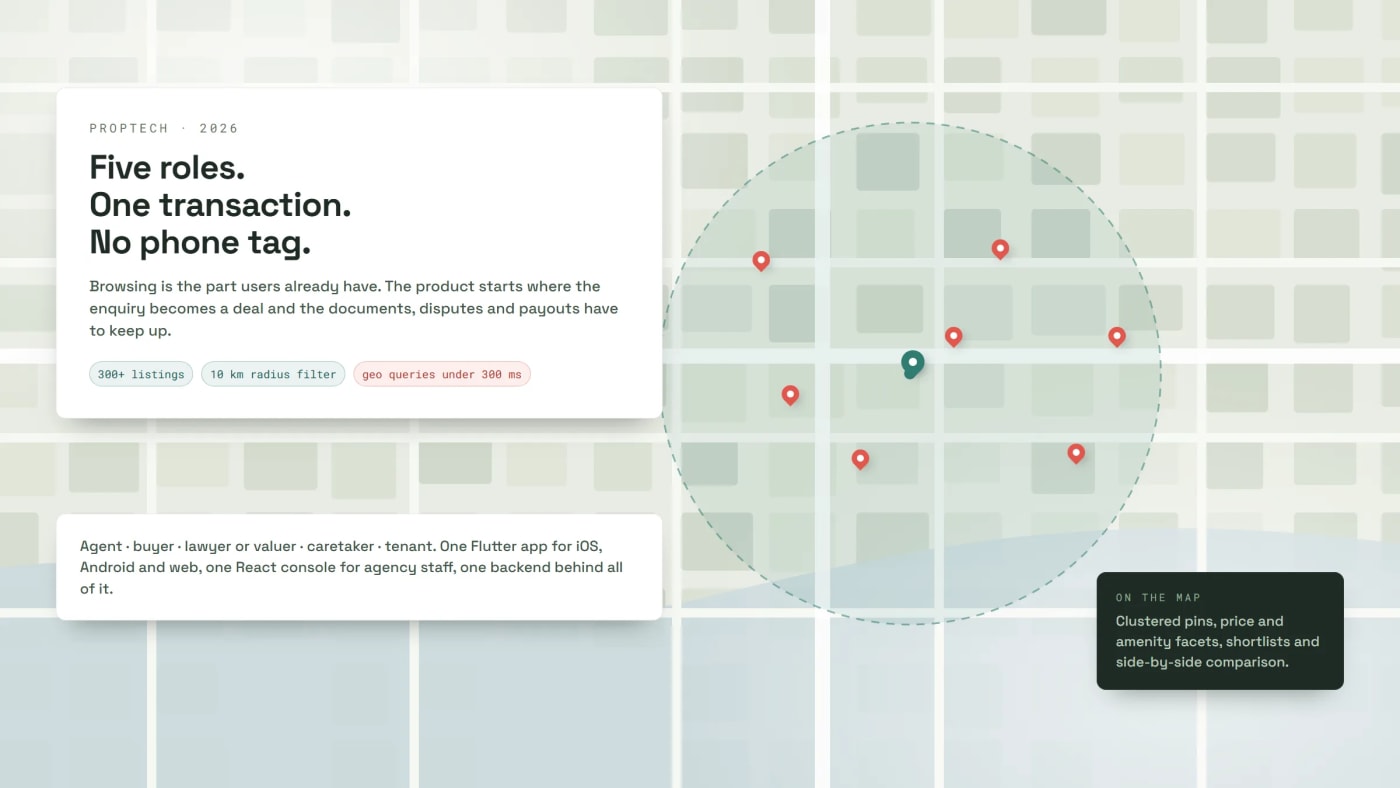
- Search that answers immediately. More than 300 listings on a clustered map with a 10 km radius filter, geo queries under 300 ms through a PostGIS spatial index and OpenSearch, and facets for price, type, bedrooms and amenities.
- An assistant on every screen. A GPT-4o co-pilot streaming over WebSocket that answers in the user's active language, produces property comparison tables and suggestion cards, and drafts the buyer questionnaire. Speech-to-text runs on the device with sherpa-ONNX, so no audio leaves the phone.
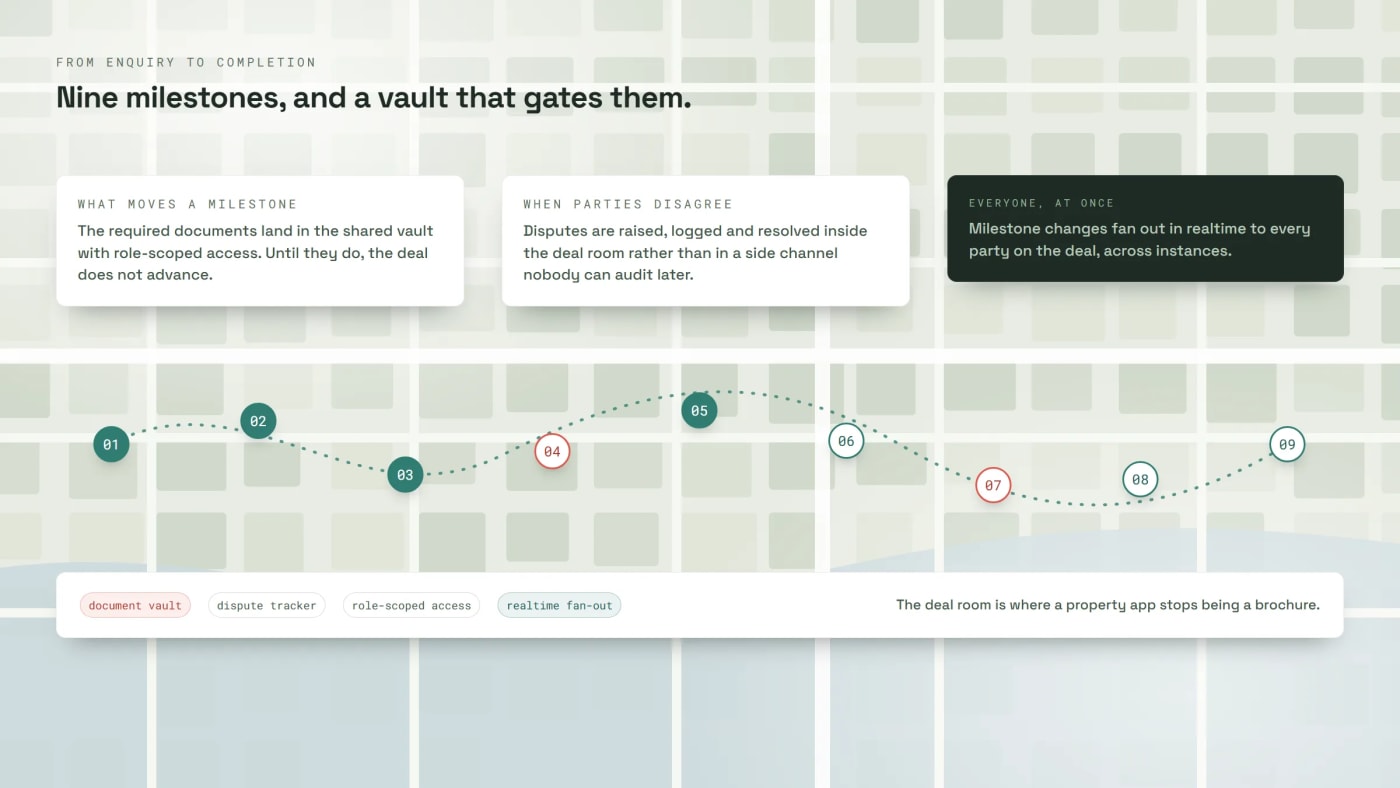
- A deal room that holds the process together. Nine sequential milestones, a shared document vault with role-scoped access, document requirements that gate progression, an inline dispute tracker, and realtime updates fanned out to every party.
- Messaging that survives bad signal. Messages appear instantly on send, queue in a local store when the connection drops, drain in order on reconnect, and get deduplicated server side so nothing arrives twice.
- Operations for the people who maintain the property. Maintenance requests with photos, a four-tier severity triage with the first tier suggested by the model, work logged with timestamps, and branded inspection reports generated as PDFs.
- Payment rails that match the market. Stripe for cards and Startbutton for M-Pesa and African mobile money, per-role subscription plans, commission payouts to agents, and a PostgreSQL ledger recording every payment event.
- Two languages, properly. Around 1,900 localised strings across web and mobile, missing keys caught at build time rather than in front of a user, and the assistant answering in whichever language the person is using.
None of that is the part anyone demos. All of it is the part that decides whether the product is used twice.
The Features Everyone Asks For
Here is the list that turns up in every PropTech brief, with an honest note on what each one costs to build properly.
Valuation
An automated valuation model reads comparable sales, location, property attributes and market movement and returns an estimate in seconds. It is genuinely useful and it is the most data-hungry thing on this list. Without clean, current sales data for your market, you are building a confident guess, and in property a confident guess is a liability.
Matching and recommendations
Behaviour beats filters. What somebody saves, revisits and lingers on says more than the criteria they typed. This one is cheap to start, because a shortlist and a comparison view already generate the signal you need, which is why our platform ships save-to-shortlist and side-by-side comparison from both map and list.
Virtual tours and staging
Generated furnishing of empty rooms is now routine, and it is a marketing feature rather than a product one. Budget for the image pipeline rather than the model: storage, transforms, signed delivery and the cost of serving large media to phones on slow connections.
Predictive market analytics
Forecasting neighbourhood movement is the feature investors ask for first and trust last. Build it after you have a year of your own transaction data, not before, and show the inputs rather than just the output.
Tenant screening
Powerful and legally loaded. Screening touches fair housing and lending rules that differ by jurisdiction, so bias testing and an explainable decision path are part of the build, not a later audit.
Conversational and voice
The assistant answers questions about a listing, a lease or a process at the hour people actually browse. Ours does it in two languages, with every structured card validated before it renders so the interface cannot show a malformed comparison. Voice earns its place where typing is awkward: on site, in a car, mid-viewing.
Document processing
Title deeds, valuations, legal opinions and inspection reports are the real currency of a transaction. The useful version extracts the fields, checks them against the deal, and keeps the original a click away. We built the harder cousin of this for construction compliance, where every finding has to cite the passage it came from.
The Architecture Underneath
- Clients. One Flutter codebase for iOS, Android and web, plus a React console for agency staff who live on a desktop. The trade-off between frameworks is in our cross-platform comparison.
- API. FastAPI with typed schemas and validation, async SQLAlchemy over PostgreSQL, Celery and Redis for anything slow, and both REST and WebSocket because a deal room is not a request-response problem.
- Search. PostgreSQL with PostGIS for spatial indexing and OpenSearch for text and distance filters. Property search is two different problems wearing one search box.
- Realtime. Socket.IO with Redis pub/sub so updates reach every instance, a raw WebSocket fallback where Socket.IO is blocked, and an offline outbox on the device.
- Media. Cloudinary for listing photos, inspection images and vault documents, with signed uploads and role-scoped access rather than public URLs.
- Identity. Keycloak SSO with role-scoped tokens enforced in middleware, agency-scoped isolation, passkeys on mobile, and an audit log on deal-room actions, payments and role changes.
Tenancy and roles are the decisions you cannot reverse later, which is the argument we made at length in the piece on building an AI SaaS product.
How to Phase It
Trying to launch all of the above at once is how PropTech projects die. The order that works:
- First, listings and search. A map, filters that are fast, saved shortlists and a comparison view. This is also your data collection phase, because matching needs behaviour before it can predict anything.
- Second, the transaction. Enquiries converting into deals, the document vault, and the milestones that keep parties moving. This is where the product stops being a portal.
- Third, operations. Tenancies, maintenance triage, inspection reports and the payment rails your market actually uses.
- Fourth, the intelligence everyone asked for on day one. Valuation, forecasting and screening, trained on the data the first three phases produced.
Each phase has to be usable on its own. More on scoping a first version in our piece on MVPs.
The Four Hard Parts
- Data that arrives inconsistent. Listings, records and private databases disagree with each other about the same property. Build the cleaning and standardising pipeline before the model, or the model learns the mess.
- Rules that differ by jurisdiction. Fair housing, privacy and lending rules shape what the model may consider and what you must be able to explain. Design for explainability at the start; retrofitting it means rebuilding the feature.
- Trust at the size of the transaction. Nobody accepts a number on a screen for the biggest purchase of their life. Show the inputs, let a person override, and record who did. Grounding answers in documents rather than in model memory is the mechanic, covered in our piece on retrieval.
- The network the user actually has. Our platform was built for markets where the signal drops mid-message. Optimistic sends, a device-side outbox and server-side deduplication are not polish, they are the difference between a usable app and an abandoned one.
What Buyers of This Work Ask
Do we need our own AI models?
Rarely at the start. Hosted models handle the assistant, the summaries and the document work. Valuation is the exception, because it has to learn from your market's transactions, and that is a data project before it is a modelling one.
Native or cross-platform?
Cross-platform for almost every property app. Ours runs iOS, Android and web from one Flutter codebase with a separate React console for agency staff, which is the split that matches how the two groups actually work.
How long does a first version take?
It depends on how much of the transaction you take on. A listings and search product is a short build. A platform that carries a deal from enquiry through to completion with documents, disputes and payouts is a different scale of work, and the scope conversation is worth having before the design one.
What about integrations with existing systems?
Plan the integration layer at the start and keep it behind an interface of your own. Listing feeds, mortgage services, title providers and government records all change on their own schedule, and the apps that survive are the ones where swapping a provider is a contained job.
Which features actually get used?
Search, shortlists, messaging and anything that removes a phone call. The analytics get demonstrated to investors and the maintenance triage gets used every single day by the person who keeps the building standing.
Build the Transaction, Not the Brochure
Most property apps stop at browsing, which is the part users already have elsewhere. The value shows up when the product carries the next step: the enquiry that becomes a deal, the document that unblocks a milestone, the maintenance request that reaches the right person with a photo attached.
Scoping one of these? Book a free 30-minute consultation, and our AI-powered mobile apps page sets out what the work involves. The platform described above is live, bilingual and carrying deals end to end, which is a different claim from a prototype.
One for the comments: if you work in property, which part of a transaction would you automate first, and which part would you never hand over?

Building AI-Powered SaaS Products, Mobile Apps & Business Automation | Trusted by Clients in 20+ Countries

Comments
No comments yet. Be the first to share your thoughts.
Leave a comment