Nobody argues about cross-platform any more. The argument now is which one, and most of the advice you will read answers that with whichever framework the agency happens to staff.
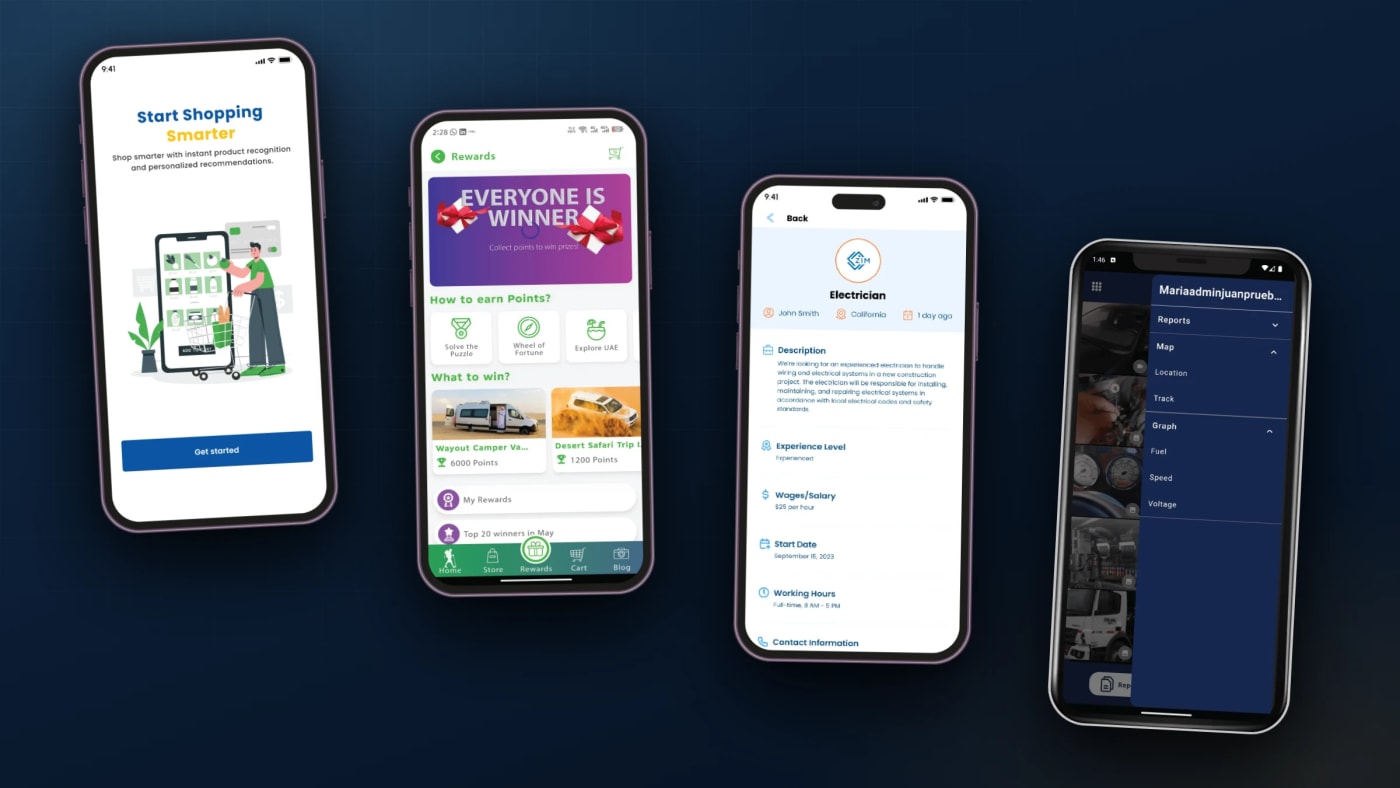
So here is ours, with the counting shown. Of our 34 case studies, 24 were built on a cross-platform framework: 22 in Flutter and 3 in React Native, with one app that uses both. That is the sample this piece is written from.
What Actually Changed in the Frameworks
Two things are worth knowing before you pick, and both are older news than most articles suggest.
React Native's New Architecture, the Fabric renderer, TurboModules and JSI in place of the old asynchronous bridge, is not a 2026 arrival. It has been mandatory since React Native 0.82, and Expo SDK 54 was the last release where it could be switched off. Expo SDK 57, out at the end of June, moved the stack to React Native 0.86 with no breaking changes.
On the Flutter side, the current stable release is 3.47, shipped in August 2026, after 3.41 in February and 3.44 at Google I/O in May. If you read somewhere that Flutter 4 is out, it is not. Google has not announced it, and every 2026 release has been a 3.x. Impeller, the rendering engine that replaced Skia, is real and is the reason Flutter animation looks the same on both platforms.
Neither framework is waiting on a breakthrough. Both are finished enough that the decision is about your team, not the technology.
Is It Fast Enough
The old objection was performance, and it still turns up with a number attached: cross-platform comes within 5% of native. There is no single benchmark behind that figure and it moves with whatever is being measured, so we would not quote it at you.
What we can say is where the line actually sits after shipping these. Lists, forms, navigation, maps, charts, camera capture and offline storage are indistinguishable to the person holding the phone. Fleet Management puts live vehicle data, routes and a lot of charts on a phone in Flutter, and nobody using it asks what it was written in. The field-service app keeps working with no signal at all, storing jobs, photos and signatures in on-device SQLite and syncing when the bars come back.
Where it does still show is sustained graphics work: a game loop, continuous video processing, or an interface that has to hold a high frame rate while something heavy runs behind it. That is native territory, and it is a small share of the apps anyone commissions.
Most apps that feel slow are not slow because of the framework. They are slow because of an image nobody resized, a list that rebuilds the whole screen, or a startup sequence that waits on three network calls before it draws anything.
One number to leave alone while you read around: the claim that cross-platform now covers 80% of new apps has no published survey behind it. The framework share figures in circulation come from developer surveys with different populations and they disagree with each other by double digits, so none of them is worth a decision.
What You Actually Save
- One codebase, one team. Features ship to iOS and Android together instead of one platform waiting on the other.
- Maintenance halves before features do. The saving compounds over the life of the product, not at launch.
- One QA pass. Testing one build is not twice as fast as testing two, it is better than that, because the bugs are in one place.
- A wider hiring pool. Dart and JavaScript developers are easier to find than a team that is strong in both Swift and Kotlin.
The cost saving usually quoted is 30% to 50% against two native builds. Treat that as an estimate rather than a measurement: the published figures range from 30% to 70% depending on who is doing the arithmetic, and none of them is a study you can read. What is not an estimate is the shape of it. One codebase costs less than two.
React Native: What It Is Good At
- Teams who already write React. The learning curve is close to zero, and that is worth more than any benchmark.
- Products with a web side. React Native Web and a shared JavaScript ecosystem keep mobile and web closer together.
- Fast iteration. The Expo managed workflow handles builds, updates and over-the-air releases without a native toolchain.
- Reaching for a package. npm has something for most problems, which shortens the distance from idea to working feature.
Flutter: What It Is Good At
- Interfaces you have designed yourself. Flutter draws every pixel, so a custom design system arrives intact rather than negotiated with platform widgets.
- Looking identical everywhere. The same widget renders the same way on both platforms, which matters when the brand is the product.
- Going past mobile. Web, desktop and embedded reuse more of the same code than React Native does.
- Animation-heavy work. Compiled to native, drawn by Impeller, consistent at high frame rates.
Flutter and React Native Side by Side
The same thing in one place, for anyone who has to put a recommendation in front of a board.
| Factor | React Native | Flutter |
|---|---|---|
| Language | JavaScript or TypeScript | Dart |
| Rendering | Native platform widgets through Fabric | Its own engine, Impeller |
| Interface consistency | Follows each platform's conventions | Identical on every platform |
| Platform targets | iOS, Android, web through React Native Web | iOS, Android, web, desktop, embedded |
| Hiring pool | Larger, because JavaScript is everywhere | Smaller, growing quickly |
| Hot reload | Yes | Yes |
| Package ecosystem | npm, very large | pub.dev, strong and growing |
| Sharing code with web | Strong, the React logic travels | Workable, Dart on the web |
| Performance | No difference a user notices in ordinary app work | No difference a user notices in ordinary app work |
| Backed by | Meta |
One row deserves a note. Performance is where every comparison wants a single number, and there is not an honest one, which is why both columns say the same thing. The difference a user can feel is covered further up, and it comes down to the kind of app rather than the framework.
Four Questions That Settle It
- What does your team write today? If the answer is React, that is the answer. Retraining a team costs more than either framework will save you.
- Is the interface yours or the platform's? A heavily designed interface favours Flutter. One that should feel native on each platform favours React Native.
- Is there a web product beside the app? Shared JavaScript pulls towards React Native. Shared visuals pull towards Flutter.
- Where does the roadmap go after mobile? Desktop and embedded are a shorter trip in Flutter.
If two answers point one way and two point the other, pick the one your team writes. That tiebreak has never been wrong for us.
What We Built With Each
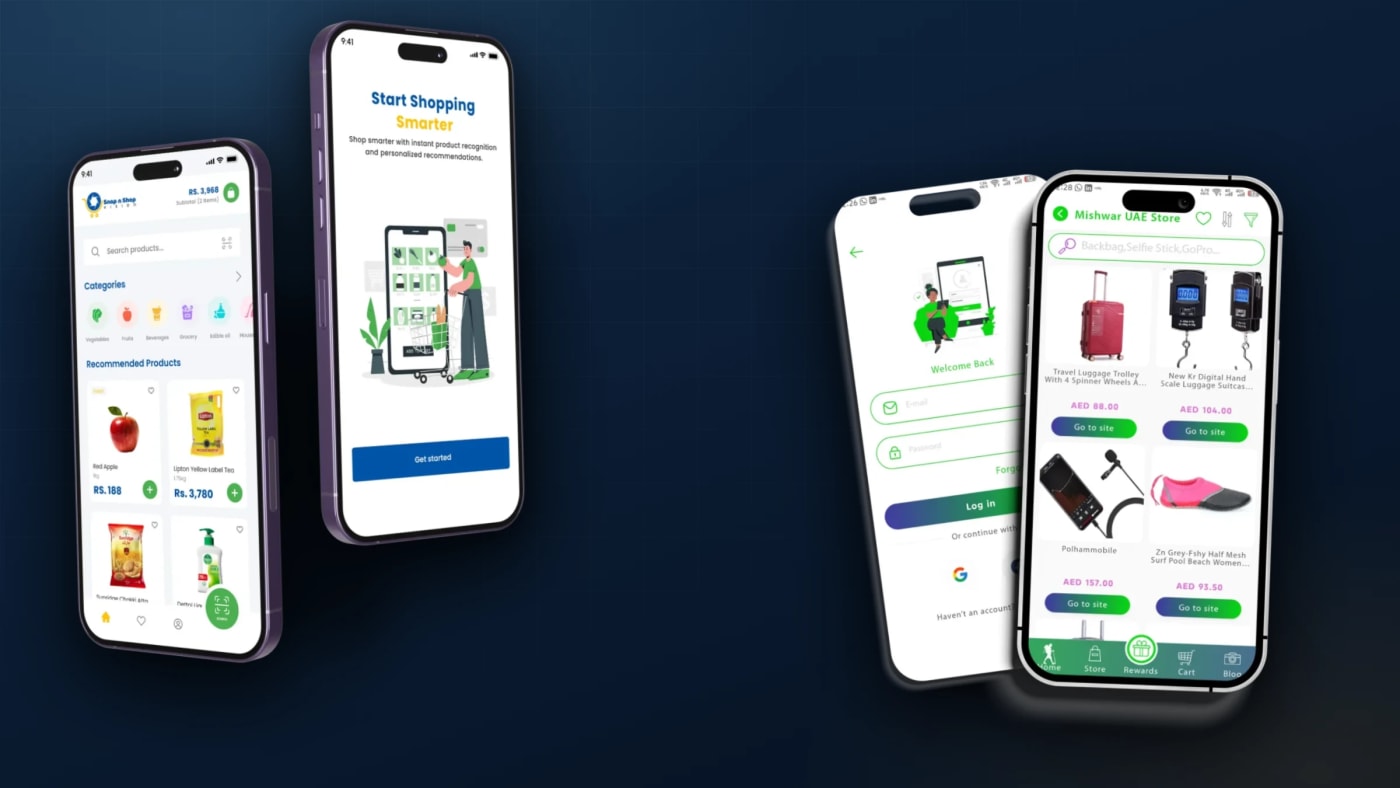
Snap and Shop is Flutter. A customer photographs a product and the app surfaces matching items from the catalogue, which puts a camera, a model and a storefront in one flow.
Miploy is Flutter, built in 60 days for Canada's blue-collar job market. AI matches workers to contracts on skills, history and fit, across a mobile app and an admin dashboard.
Fleet Management is Flutter, and the least glamorous of the four: vehicle health, driver performance, routes and AI-driven alerts, which is to say maps, live data and a lot of charts on a phone.
MishwarUAE Travel is the React Native one. An AI travel companion that builds UAE itineraries from a traveller's preferences, with a store, rewards and bookings alongside.
Four products, two frameworks, and in every case the framework was chosen for the team and the roadmap rather than the other way round.
One of Them in Detail
Miploy is the clearest example of why the framework mattered less than the schedule. Sixty days to a working marketplace meant one codebase was the only way the dates worked, and Flutter was what the team wrote.
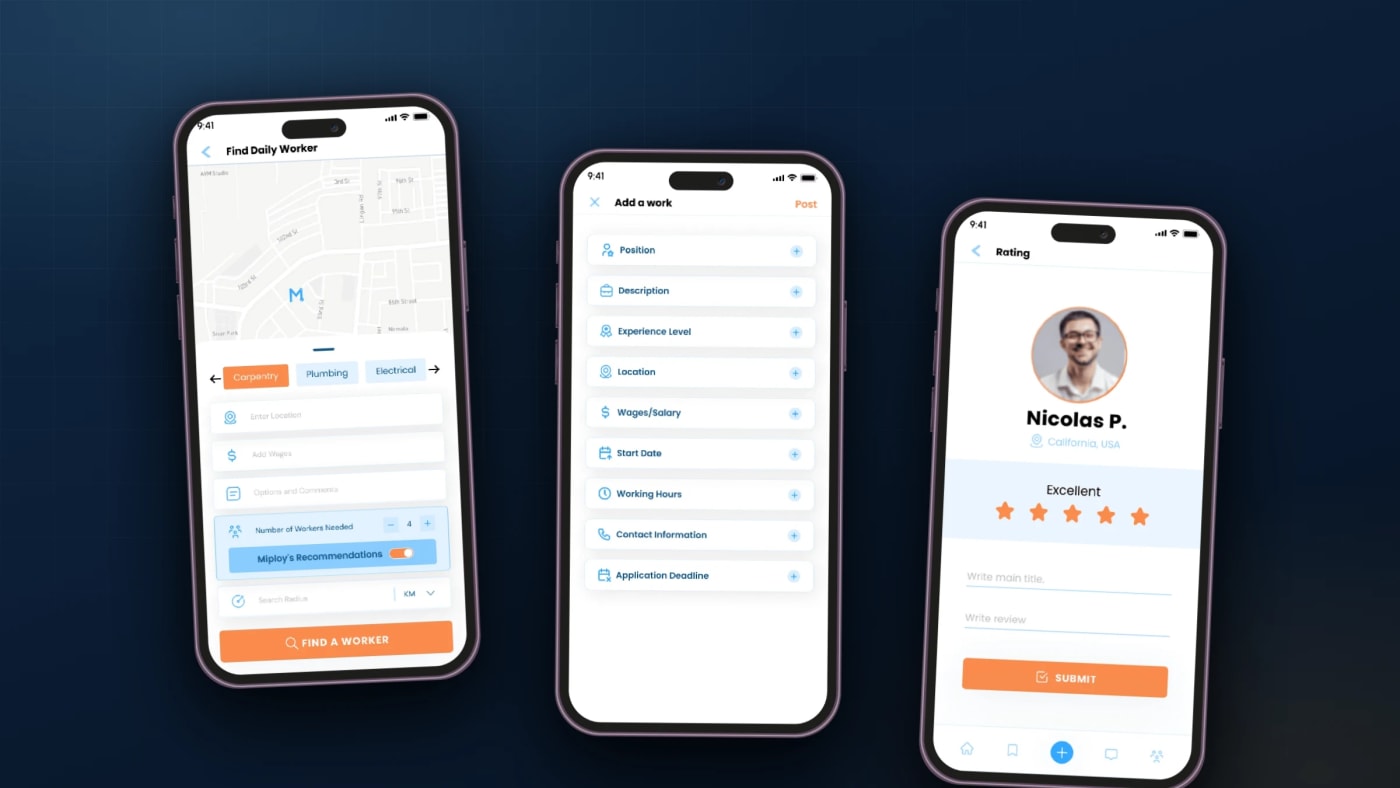
The thing that would have slowed a native build is visible in those three screens. They share components, validation and state. Written twice, they would have drifted apart within a month.
What AI Actually Changes About the Build
Every second brief now has AI in it, and the framework is almost never the constraint. What matters is where the model runs and what the app is allowed to send out.
The shapes it takes in practice:
- A conversation inside the app that can act, not one that only answers.
- Voice as an input, including dictation that comes out as a structured record.
- The camera as a scanner: products, documents, damage, condition.
- Personalisation driven by behaviour instead of a settings screen.
- Generated content, whether that is a plan, a summary, a quote or a report.
- Work that happens in the background without anyone pressing a button.
Ours sit across that list. AI-APEX is Flutter, with GPT-4o generating training and meal plans and TensorFlow.js with Roboflow doing photo-based body comparison. Snap and Shop turns the camera into the search box. Butler AI, inside the field-service app, is the clearest case of the trade-off: speech recognition runs on the device with Sherpa-ONNX so no audio leaves the phone, then a model drafts the quote and pgvector searches previous jobs for the context behind it.
That is the real decision inside an AI feature. On the device keeps the data on the phone, survives a dead signal and costs nothing per call, but limits how big a model you can use. In the cloud gives you the strongest model available and a bill per request. Both frameworks reach both, which is why AI belongs in the product conversation rather than the framework one.
Five Things Moving in 2026
- Agents inside the app. The AI stops sitting in a chat box and starts doing the step. Butler AI takes a spoken description of a job and returns a priced quote, which is a feature rather than a chatbot.
- Inference on the device. Privacy, latency and offline behaviour all improve at once when the model runs locally. Both frameworks have plugin paths to on-device runtimes, and we have shipped one.
- One app instead of four. Separate services keep getting folded into a single app. MishwarUAE carries itineraries, a store, rewards and bookings in one build, which is only affordable on one codebase.
- Design handed over as code. Figma to Flutter and Figma to React Native tooling is closing the distance between a design file and a working screen. Treat the output as a starting point, because state and edge cases are still yours to write.
- Privacy as a default rather than a policy page. Collect less, keep what you can on the device, and make consent legible. Offline-first storage and on-device models help here as a side effect.
How to Judge a Mobile Partner
Most of this decision is not about frameworks at all. Four things worth asking anyone who sends you a quote:
- Can they argue for the framework they are not recommending? A team that only writes one will recommend that one every time, whatever your own engineers write.
- Have they shipped AI past a demo? Calling an API is not the same as running inference on a phone, handling a model that returns nonsense, or paying for the tokens at volume.
- Do they own the back end as well? The app is the visible tenth of the product. If the API, the data model and the infrastructure belong to somebody else, the gaps between vendors become yours.
- Will they show the counting? Ask how many apps, in which framework, and what happened after launch. Ours is at the top of this piece: 24 of 34 case studies cross-platform, 22 in Flutter, 3 in React Native, one app using both.
What Clients Ask Before Picking One
Can cross-platform handle a complex app?
Yes, and the four above are not simple. Camera pipelines, live maps, role-based dashboards and real-time data all run fine. The honest exception is sustained high frame rate graphics work, which is still native territory.
Flutter or React Native for a startup?
Whichever your first two engineers already write. The wrong answer is two native apps, which spends on parity the money that should go on finding out whether anyone wants the product.
How long does an MVP take?
Miploy reached a working marketplace in 60 days. That is a realistic marker for a focused first version rather than a promise, and the time goes into integrations and testing, not the framework.
What about the AI features everyone wants?
Both frameworks connect to cloud models and on-device inference without trouble, so it is not part of the framework decision. We wrote that side up separately in our piece on AI-native mobile apps.
Who else ships on these frameworks?
Both projects keep an official list, Flutter's showcase and React Native's showcase, and either is more use than an agency's claim. Pick an app off one of them and the point makes itself, because you cannot tell from using it.
Does the AI have to run in the cloud?
No. On-device inference is routine now, and in Butler AI the speech never leaves the phone at all. The rule we use: on the device when the data is sensitive, the network is unreliable or the call happens constantly, and in the cloud when you need the strongest model there is.
Three Lines and You Are Done
Write down what your team writes, how custom the interface has to be, and what comes after mobile. Three lines. The framework falls out of them, and it is a smaller decision than the time spent arguing about it suggests.
If you want a second opinion on those three lines, we run free 30-minute consultations, and our AI-powered mobile app development page sets out how a build runs. Across 103 reviews on Upwork our average job feedback is 4.99, and we have been shipping since 2020.
One for the comments: if you have shipped on both, which one would you not use again, and what made the difference?

Building AI-Powered SaaS Products, Mobile Apps & Business Automation | Trusted by Clients in 20+ Countries
Comments
No comments yet. Be the first to share your thoughts.
Leave a comment