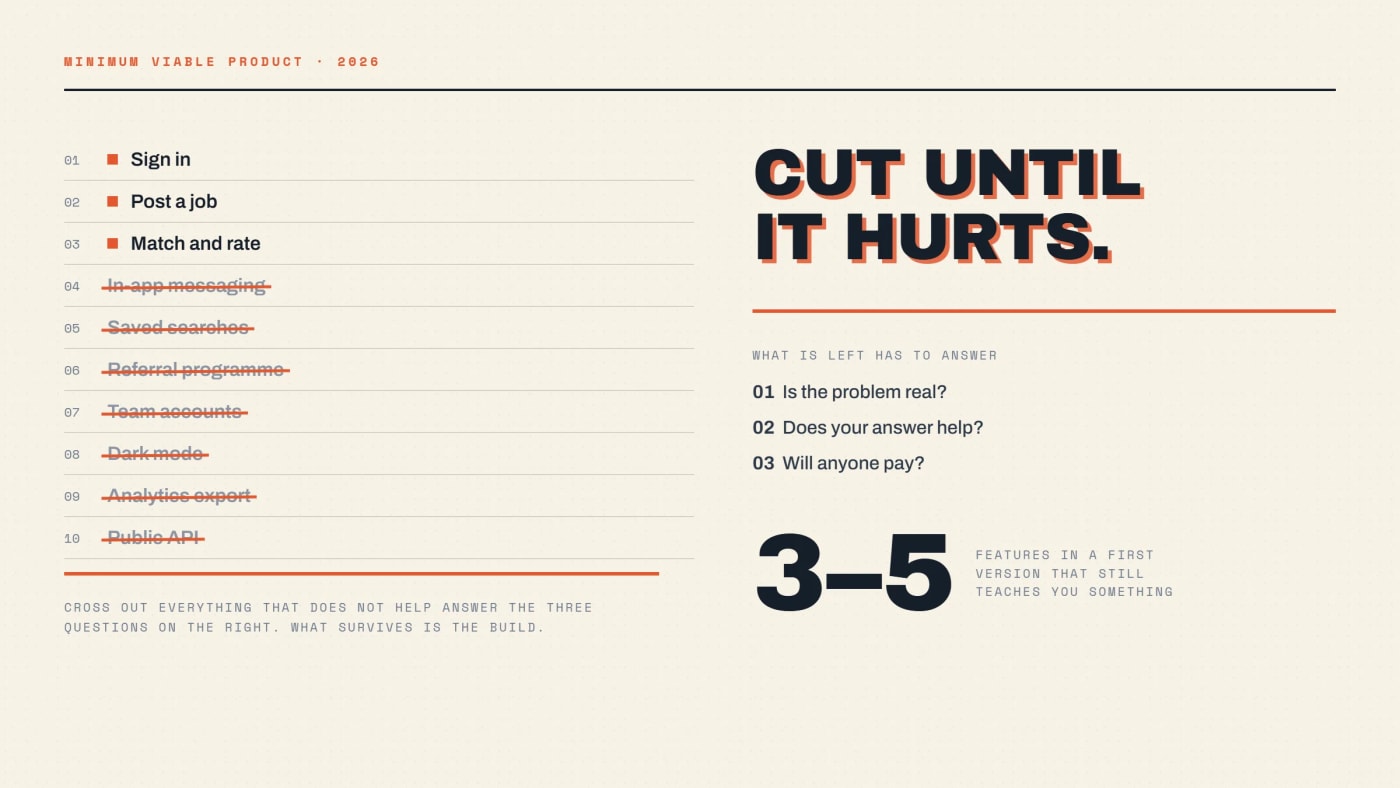
A startup MVP is not a smaller product. It is an instrument for answering three questions before the money runs out: is the problem real, does your answer to it work, and will anyone pay.
Everything else people argue about, the framework, the design system, the hosting, is downstream of those questions. This is how we scope and build one in 2026, what has genuinely changed, and what we cut from our own builds to get them out of the door.
What an MVP Has To Do
The minimum in minimum viable product gets the attention and the viable does the work. A prototype nobody can use answers nothing. The version you want is the smallest thing a real person can complete a real task with, and then tell you whether they would do it again.
- Does the problem exist? Not in your head, in somebody's week. If people have not built a workaround for it already, it may not hurt enough to pay for.
- Does your answer actually help? People will use it the way they want to, which is rarely the way the roadmap imagined.
- Will they pay? Enthusiasm is free. The only honest signal is money, a renewal, or a booking.
An MVP that does not produce evidence on those three is just an early version of a product you have not validated.
What Changed by 2026
Two things, and both of them shorten the distance between an idea and a working product.
Cross-platform has stopped being a compromise. One team can ship iOS and Android from one codebase, and the frameworks are finished enough that the decision is about your team rather than the technology. We laid out the current state of both, including the claims that are not true, in the Flutter and React Native comparison. Two of those matter here: there is no Flutter 4, and the popular line that cross-platform comes within 5% of native has no single benchmark behind it.
The second change is that AI stopped needing a specialist. Image recognition, matching, summarising, conversation and voice all arrive through APIs now. For an MVP that means an AI feature is days of integration rather than a hire, which matters when the AI is the reason the product exists.
On cost, the ranges that circulate are not measurements, so we will not repeat them. What is true is that scope sets the price, not the framework, and that one codebase costs less to build and far less to maintain than two.
The Five Stages, Honestly
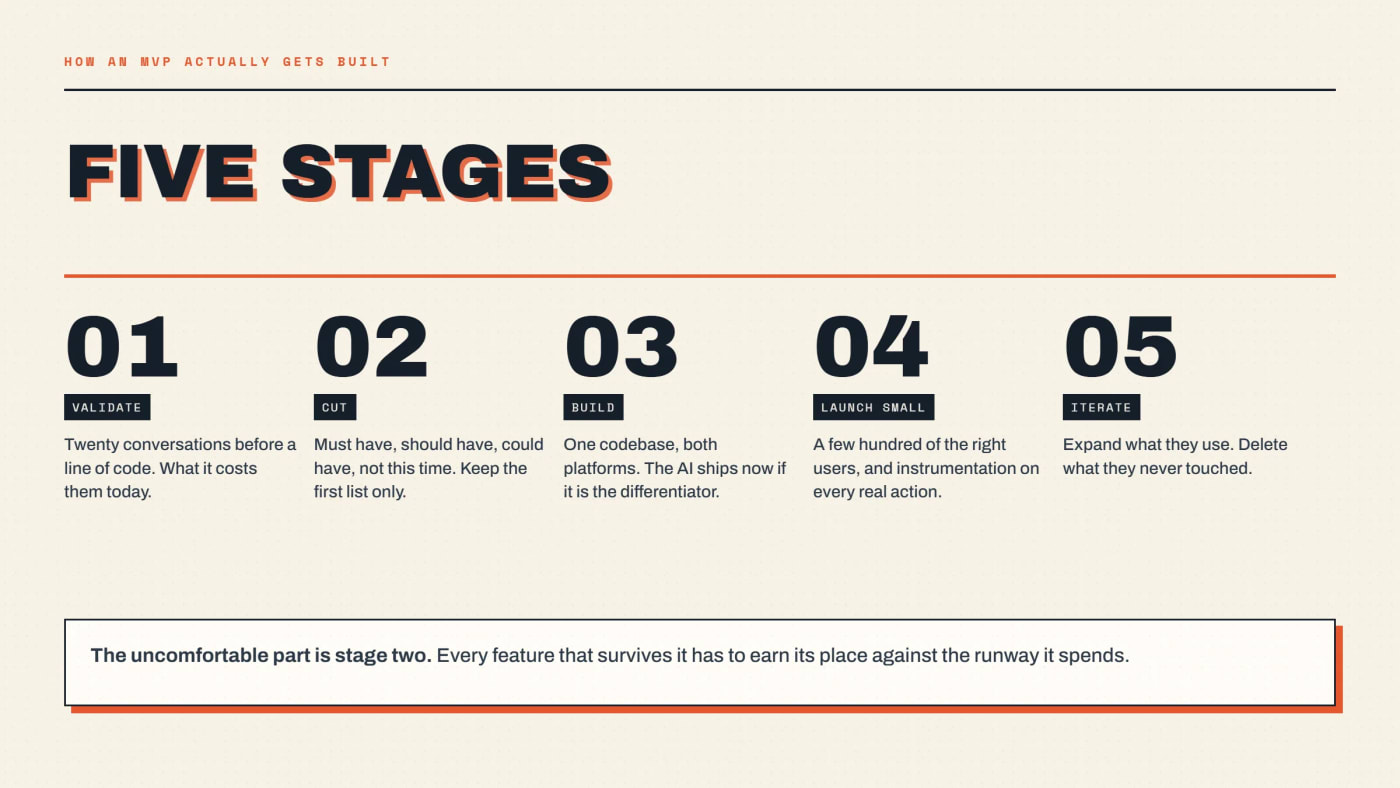
1. Validate before you build
Twenty to thirty conversations with people who have the problem. What they do today, what it costs them, what they have already tried. Then look at what exists: competitors tell you what the market will pay for, and their gaps tell you where you fit. Write the value in one sentence. If it takes a paragraph, the product is not clear yet.
This stage costs nothing in engineering and saves the most money of any stage in the list.
2. Cut the scope until it hurts
The expensive mistake is building features nobody asked for. Sort every idea into must have, should have, could have and not this time, and keep only the first group. A well-scoped MVP is three to five features. Anything more and you are testing a bundle rather than an idea.
A useful test: if a feature were missing on launch day, would the product still answer the three questions? If yes, it is not in the MVP.
3. Pick the stack and build
The framework choice comes down to what your first engineers already write. React Native if that is JavaScript, or if a browser product will share logic with the app. Flutter if the interface is heavily designed or the roadmap runs past phones. Both are fine, and retraining a team onto the other one is not.
If AI is your differentiator, it belongs in this build and not in version two. Shipping the product without the thing that makes it different means validating a product you are not planning to sell.
4. Launch small, on purpose
An MVP launch is a controlled release, not an announcement. A hundred to five hundred of the right users, instrumentation on every meaningful action, and a way for people to tell you what went wrong without leaving the app.
Four numbers are worth more than the rest: how many people reach the core action, how many come back, how often the main feature is used, and how many will pay. Everything else is decoration at this stage.
5. Iterate, and delete things
The data decides what to build next, and the harder discipline is removing what nobody touched. This is where one codebase pays its biggest dividend, because each iteration reaches both platforms at once and the feedback loop stays tight.
Three of Ours, and What They Cut
Of our 34 case studies, 24 are cross-platform. Three of them make the MVP argument well.
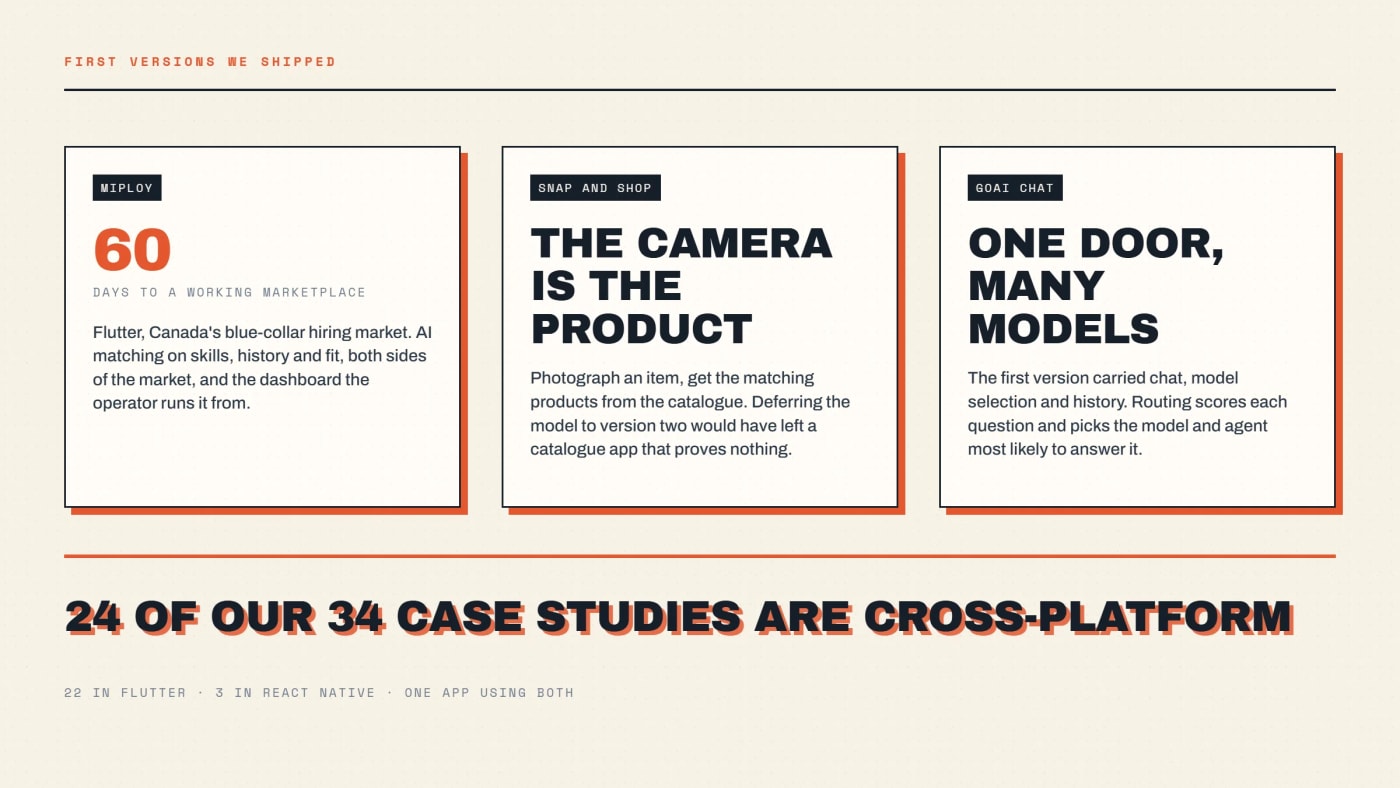
Miploy is the clearest. Flutter, Canada's blue-collar hiring market, and a marketplace that worked after sixty days of building. The AI does the matching on skills, history and fit, there are two sides of the market to serve, and the operator runs the whole thing from a dashboard. That schedule only holds with one codebase and a feature list somebody was prepared to defend.
Snap and Shop is the opposite lesson. Its whole proposition is that you photograph a product and the app finds matching items in the catalogue. Deferring the camera and the model to a later version would have left a catalogue app that proves nothing. When the AI is the product, the AI is the MVP.
GoAI Chat tested a different hypothesis: that people would rather reach several models through one interface than switch between tools. The first version carried the chat, the model selection and the conversation history, and the routing underneath it scores each query and picks the model and agent most likely to answer it. What users reached for most is what told the team where to go next.
Five Ways MVPs Go Wrong
- Building too much. Every unvalidated feature is a bet placed with money you cannot replace. The most common cause of a startup running out of runway is a roadmap nobody cut.
- Going native without a reason. Unless the product needs deep hardware work, two native codebases buy parity with budget that should have gone into finding out whether anyone wants it.
- Treating design as optional. People decide how they feel about a product in the first half minute. Three features that look considered beat ten that do not.
- Shipping without analytics. If you cannot see where people stop, the next release is a guess. Instrument the core flow before launch, not after the first confusing week.
- Postponing the AI. If the intelligence is the differentiator, a version without it is a different product wearing the same name.
What We Do With Founders
The part founders usually want help with is not the code. It is deciding what not to build, and doing it without losing the thing that makes the product worth using.
- Scoping that survives contact. We argue the feature list down with you, and we say which parts we think are wrong.
- Both frameworks, honestly. We write Flutter and React Native, and we will recommend the one your team can carry rather than the one we prefer.
- AI that earns its place. Conversation, vision, matching and voice, integrated where they change the product rather than decorate it.
- A back end that can grow. A successful MVP should not need a rebuild. How we structure one for scale is set out in the piece on building an AI SaaS product.
What Founders Ask Us First
What does an MVP cost?
It is set by scope, not by framework. The honest drivers are how many features survive the cut, how many outside systems you have to integrate with, whether the AI is a call to an API or something you have to build, and whether anything regulated is involved. Anyone quoting a range before asking those is guessing at your product.
How long does it take?
Sixty days, in Miploy's case. Treat that as a marker rather than a promise, and expect the weeks to go on integrations and testing rather than on the framework. Cutting scope buys time faster than any tooling decision will.
Flutter or React Native for a first version?
Whatever your first two engineers already write. With nobody hired yet, let the product decide: a heavily designed interface or ambitions past phones point to Flutter, while shared logic with a browser app points to React Native.
AI now or in version two?
Now, if it is the reason the product is interesting. Later, if it is an enhancement. The question to ask is whether a user could describe your product accurately without mentioning the AI. If they could not, it belongs in the first version.
Why do most MVPs fail?
They were never minimum. A feature-complete first release spends the runway before the hypothesis has been tested, and by the time the data arrives there is no money left to act on it.
Ship the Version That Teaches You Something
Write down the three questions. List every feature. Cross out everything that does not help answer them. What is left is your MVP, and it will feel uncomfortably small, which is the point. The product that wins is rarely the one that launched with the most.
If you want help making those cuts, we offer a free 30-minute consultation, and our AI-powered mobile apps page covers how a build runs. We have taken products from first call to launch since 2020, with an Upwork feedback average of 4.99 across 103 reviews.
One for the comments: what did you cut from your first version, and did you ever end up building it?

Building AI-Powered SaaS Products, Mobile Apps & Business Automation | Trusted by Clients in 20+ Countries
Comments
No comments yet. Be the first to share your thoughts.
Leave a comment