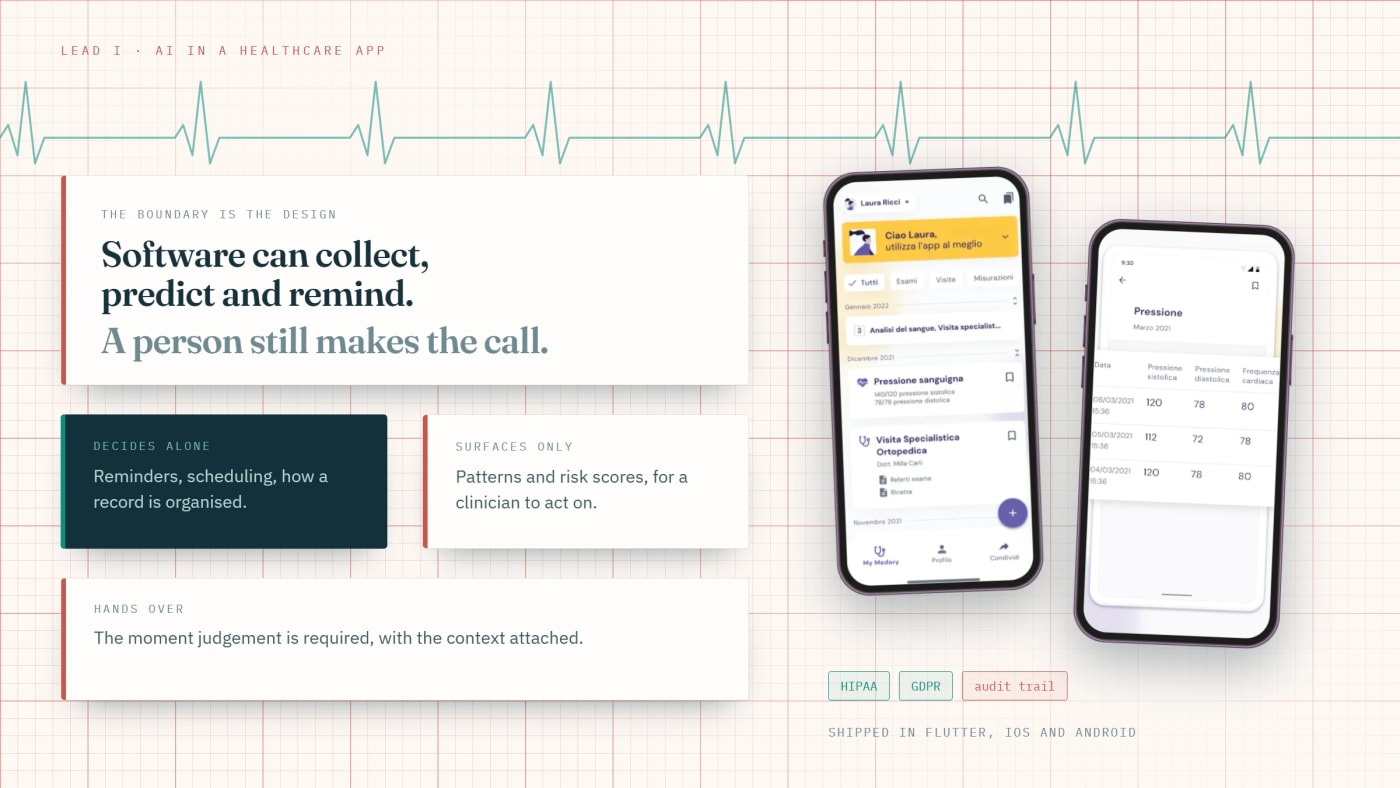
Most software is allowed to be wrong occasionally. A missed reminder is an annoyance and a bad recommendation is a refund. Health software has no such margin, which is why the useful question is not what AI can do inside a health app. It is what the AI is allowed to decide.
This is about the parts that hold up: where AI earns its place in a patient-facing app, what HIPAA changes about the way the thing is built, and what has to be true before a clinician will act on anything a model says.
Two numbers turn up in almost every article on this subject. That healthcare is the fastest growing segment for AI voice agents at 42% a year, and that three quarters of SaaS companies will have AI in a core process by the end of 2026. We went looking for the sources and neither survives the check: both trace back to secondary sites quoting each other. The case for this work does not need them.
Where AI Earns Its Place
Diagnostics and triage
The honest framing is decision support. A model reads images, symptoms or lab values, surfaces what looks unusual and puts the queue in a sensible order. It does not diagnose. The clinician does, and the system has to show enough of its reasoning that the clinician can disagree with it quickly.
Keeping patients engaged
This is the least glamorous category and the one with the clearest return. Reminders tied to an actual treatment plan rather than a generic schedule, discharge instructions somebody can ask questions about, follow-up after a procedure, and booking that does not depend on a receptionist being free.
Our nearest build is veterinary rather than human. The pet care booking agent answers the phone for grooming, vet and boarding appointments, picks the right staff member as well as the right slot, and writes the record into the CRM on the call. A clinic's scheduling problem is the same shape, and we wrote up what makes those agents work in the piece on voice agents.
Prediction instead of reaction
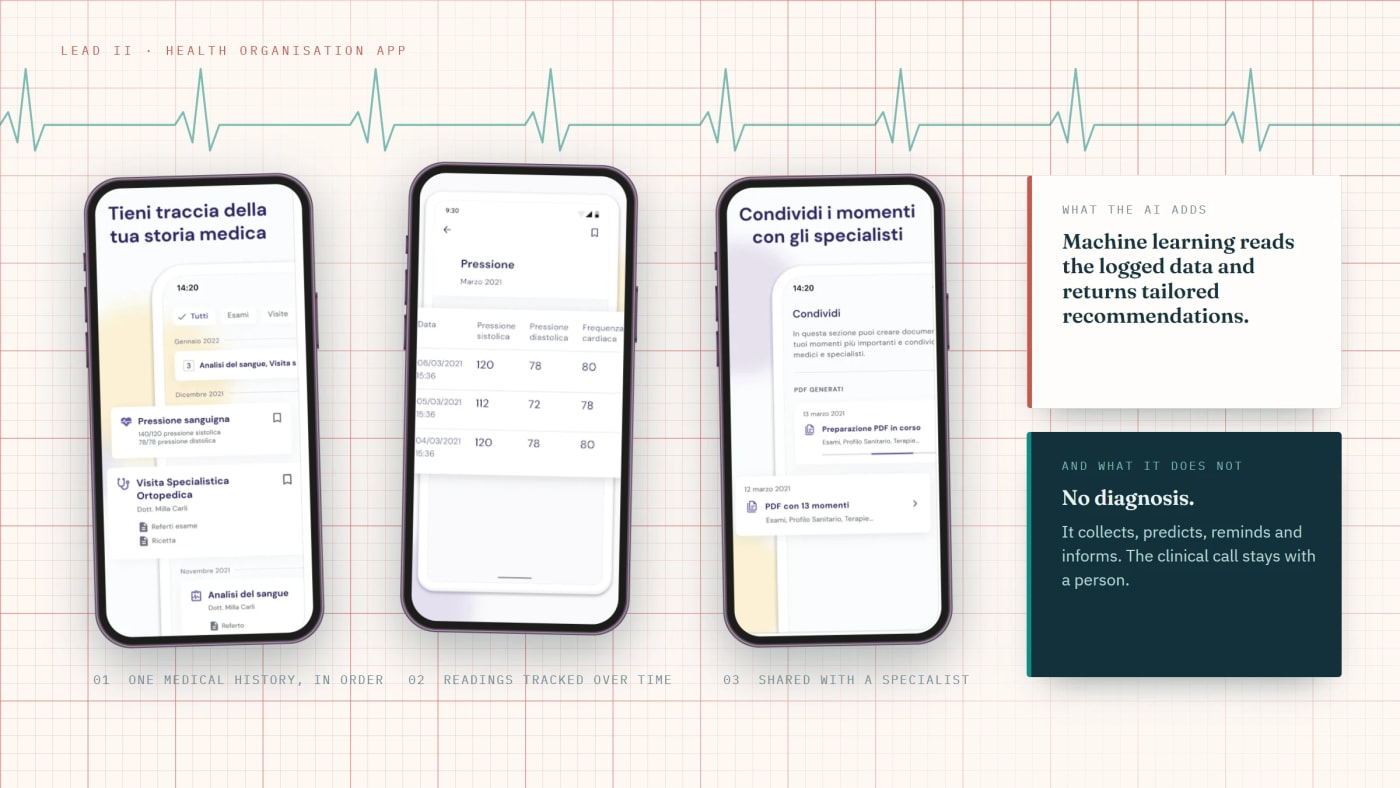
Our health organisation app is the clearest example in our own work. It is a Flutter build for iOS and Android where machine learning reads the user's health data and returns tailored recommendations, with interactive dashboards for trends and real-time sync so the person and their provider are looking at the same picture rather than two versions of it.
The same machinery runs outside clinical care. AI-APEX uses GPT-4o for training and meal plans and photo-based body comparison for progress, and adjusts both as the person changes. It is wellness rather than medicine, but the personalisation loop is identical to the one chronic care programmes need.
Telehealth and remote monitoring
The video call stopped being the product some time ago. What matters around it is triage before the appointment so the clinician is not spending the first five minutes collecting history, relevant records surfaced during the call, automated check-ins afterwards, and a dashboard that pulls readings from blood pressure cuffs, glucose meters and pulse oximeters and raises a flag when a trend turns.
Mental health support
Availability and privacy are the real advantages here. An app is reachable at two in the morning and it does not raise an eyebrow. The design constraint is the handoff: the system has to recognise when it is out of its depth and route the person to a human, with context, rather than keep talking. Support for therapy, never a substitute for it.
Health content at scale
Patient education, clinical guidance and public health material all have to be produced faster than anyone can write them and be correct. Medd AI is our answer to that. Nothing it produces leaves on a single model's word. Gemini writes the draft with AMA citations put in as it goes, a second pass by GPT-4o asks whether those claims and references hold up and whether a patient could follow the prose, and a draft that fails that pass comes back with an issue log attached. If the brief arrived without sources, Perplexity is sent to find them before any writing starts.
What HIPAA Changes About the Build
If the app touches protected health information in the United States, compliance is not a feature at the end. It reaches into every layer:
- Encryption on both sides. At rest and in transit, with key handling that somebody can actually explain in an audit.
- Access by role. Who can see which record, enforced in one place rather than per screen.
- An audit log that is not optional. Every read of patient data recorded, because the question later is always who saw what and when.
- Agreements with every third party. Cloud, analytics and the model provider all need a business associate agreement before any patient data goes near them.
- Less data, deliberately. Collect and send the minimum the feature needs. The cheapest way to reduce exposure is to have less of it in flight.
Our health organisation app shipped with HIPAA and GDPR protocols, encrypted cloud storage and strict authentication built into the architecture rather than added afterwards. That ordering is the whole lesson. Retrofitting compliance means revisiting the data model, the logging and every integration at once.
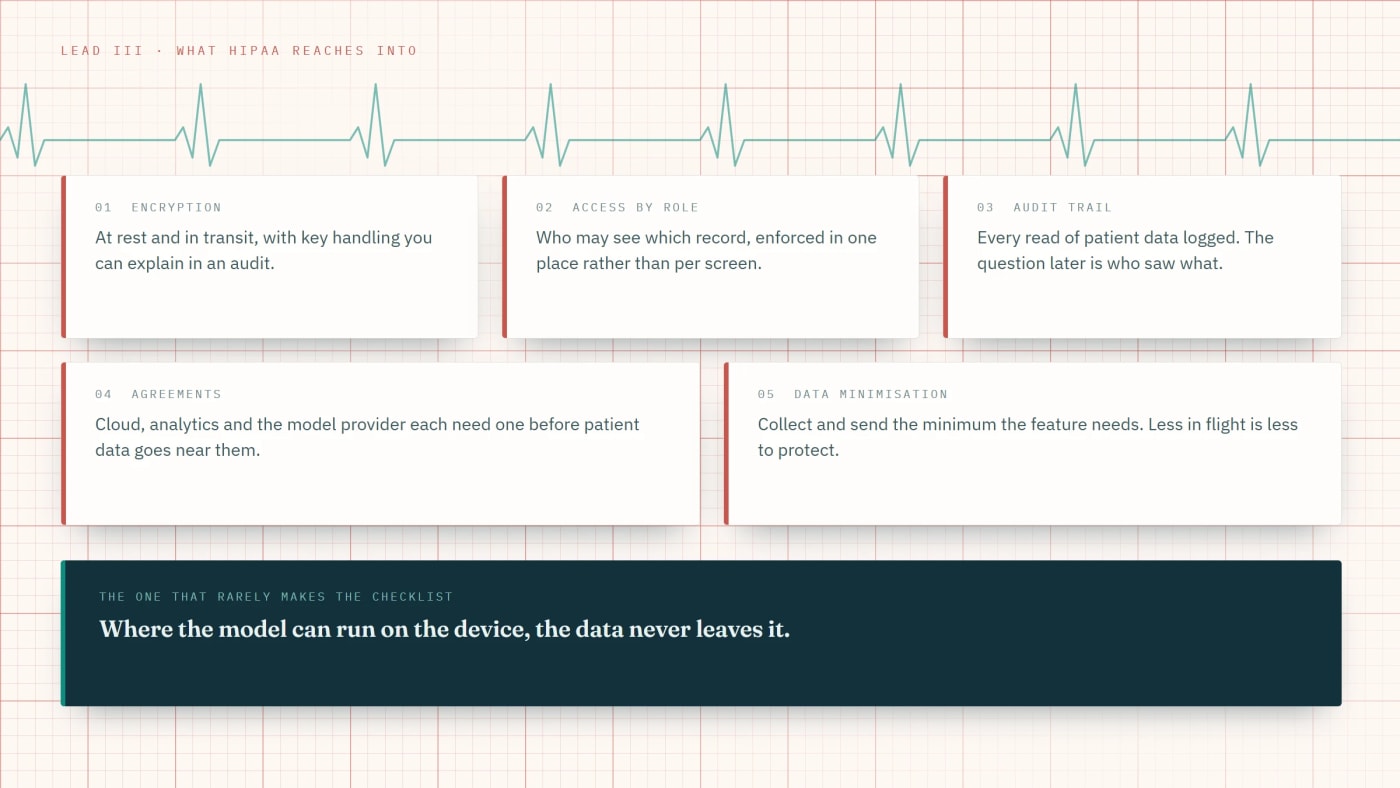
One more point that rarely appears in compliance checklists. Where a model can run on the device, the data never leaves it. We use that pattern outside healthcare already: speech recognition in our field-service platform runs on-device with Sherpa-ONNX so no audio is sent anywhere. In a health app the same choice is worth real money in reduced exposure.
The Engineering Decisions That Matter
- One codebase, two platforms. Patients arrive on both, and parity matters more here than in most products. Our health app is Flutter; the trade-off against React Native is laid out in the cross-platform comparison.
- Offline is not optional. Hospitals have thick walls and bad signal. The app has to keep working and sync afterwards, which is the pattern our field-service build uses with a local database and a prioritised sync queue.
- Biometric entry. Face or fingerprint unlock is the difference between a password written on a note and a session nobody else can open.
- Devices over Bluetooth. Glucose monitors, cuffs and oximeters each have their own quirks, and pairing is where the support tickets come from.
- Accessibility as a requirement. Screen readers, adjustable text, high contrast. A patient population includes people who cannot read small grey type, and in this sector that is not an edge case.
Validating the Model, Not Just the App
Shipping a health feature means two sets of tests. The ordinary software ones, and the ones about whether the model should be trusted at all.
- Check it against the standard. Compare what the model suggests with the established guidance, on cases where the answer is already known.
- Audit it for bias. Performance has to hold across the demographics the app actually serves, not just the average of the training set.
- Watch it in production. Accuracy drifts as inputs change. Somebody has to own the number and the retraining that follows it.
- Make it explainable. A clinician who cannot see why will not act on it, and they are right not to.
The arrangement we trust is grounding plus a second opinion. Medd AI has one model audit the other's draft. On our building-code compliance platform, every finding carries the passage it was judged against, so a reviewer checks rather than trusts. That is the same discipline a clinical recommendation needs, and we set out how retrieval makes it possible in the piece on RAG chatbots.
What We Have Built in Health
Three patient-facing products and one for the people producing what patients read. The health organisation app covers tracking, prediction and provider dashboards on a HIPAA and GDPR compliant base. AI-APEX handles adaptive fitness and nutrition. Our diet and nutrition apps do personalised guidance from logged intake. Medd AI produces medical content with its citations attached.
What we have not done is the part worth saying out loud: none of these diagnose. They collect, they predict, they remind and they inform, and a person remains responsible for the clinical call. That boundary is a design decision, not a limitation we are waiting to remove.
What Clients Ask About Health Apps
What drives the cost?
Scope first. One AI feature inside an existing app is a short build. A platform with monitoring, provider dashboards and record integration is a different order of work. Compliance adds to it in every case, through architecture, logging and review time, and it is not a line anybody gets to remove.
Can AI replace a doctor in the app?
No, and an app that implies otherwise invites both regulatory and ethical trouble. The model processes volume, spots patterns and surfaces what matters. The decision stays with the clinician, and the interface should make that obvious to the patient reading it.
Which AI technologies are actually used?
Four, mostly. Language models for communication and content, computer vision for images, predictive models for risk scoring, and retrieval so the answers come from approved material rather than the model's memory.
How is patient data kept private?
Encryption, access by role and audit logging as the base. Then the choices that reduce exposure rather than protect it: send the minimum, keep processing on the device where the feature allows, and sign agreements with every service that touches the data. Security review and penetration testing before launch, not after the first incident.
Flutter or React Native for a health app?
Both can carry it. Flutter suits a heavily designed interface that must look identical on every device, which is why our health app uses it. React Native suits a team already writing React or a product with a web side. The framework is not the compliance risk; the data handling is.
Start With the Decision, Not the Model
Name the decision the app is involved in. Write down what the AI may decide on its own, what it may only surface for a person, and where it must stop and hand over. Then design the data handling that makes it legal and the evaluation that makes it trustworthy. The model comes last and it is the easiest part to change.
If you are scoping one, we offer a free 30-minute consultation, and our AI-powered mobile apps page covers how a build runs from MVP to launch. Nine years of shipped products sit behind that page, and the Upwork feedback across them averages 4.99.
One for the comments: if you work in health, what is the one task you would hand to software tomorrow, and what is stopping you?

Building AI-Powered SaaS Products, Mobile Apps & Business Automation | Trusted by Clients in 20+ Countries
Comments
No comments yet. Be the first to share your thoughts.
Leave a comment