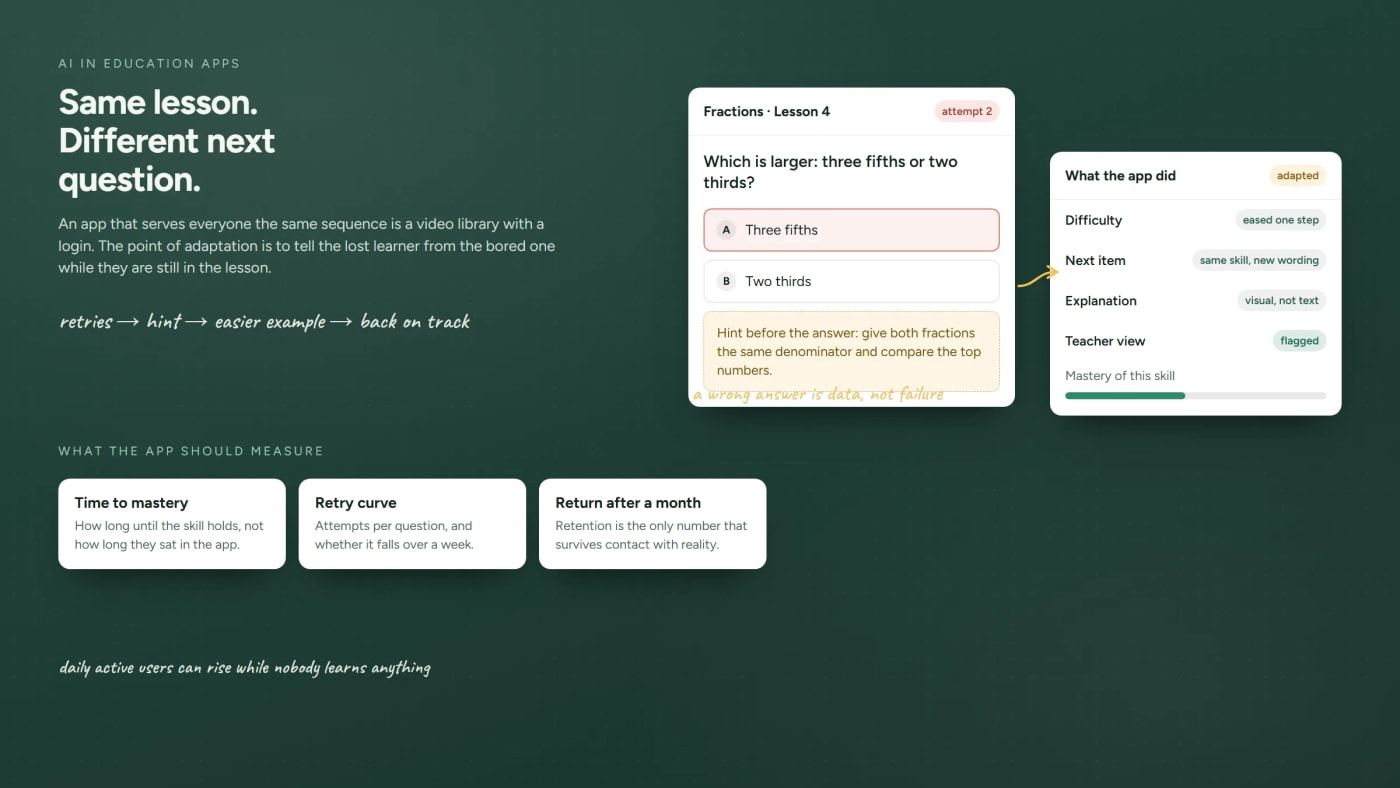
An education app that serves every learner the same sequence is a video library with a login. The content may be excellent. The person who is already lost stays lost, and the person who is bored leaves.
What AI changes is not the content. It is that the app can tell the difference between those two learners while they are still in the lesson, and do something about it before either one closes the tab.
The market figures attached to this subject are worth ignoring. The $320 billion EdTech market, the 41.5% compound growth in education AI, the 86% of institutions using generative AI, the tripled retention, the 40% fluency gains, none of them survive a look for the original study. What follows comes from apps we built.
What Actually Changed
Three things, and only the third is about models.
- Expectations arrived from elsewhere. People who get recommendations everywhere else notice immediately when a course does not react to them at all.
- The data was already there. Time on a question, retries, where people stop, which explanation they replay. Learning apps have always produced this and mostly thrown it away.
- Tutoring stopped being hand-written. Before language models, an explanation for every wrong answer had to be authored in advance. That is why adaptive learning used to mean three difficulty levels and a branching tree somebody maintained by hand.
The Capabilities That Matter
Adaptive learning that actually adapts
Our online coaching app is an AI tutor for a physical skill rather than a school subject, which makes the mechanics easy to see. It diagnoses where the learner's gaps are, builds a practice plan from that, adjusts content complexity per learner, and scores difficulty dynamically as they improve. Feedback arrives in the session rather than in a weekly report.
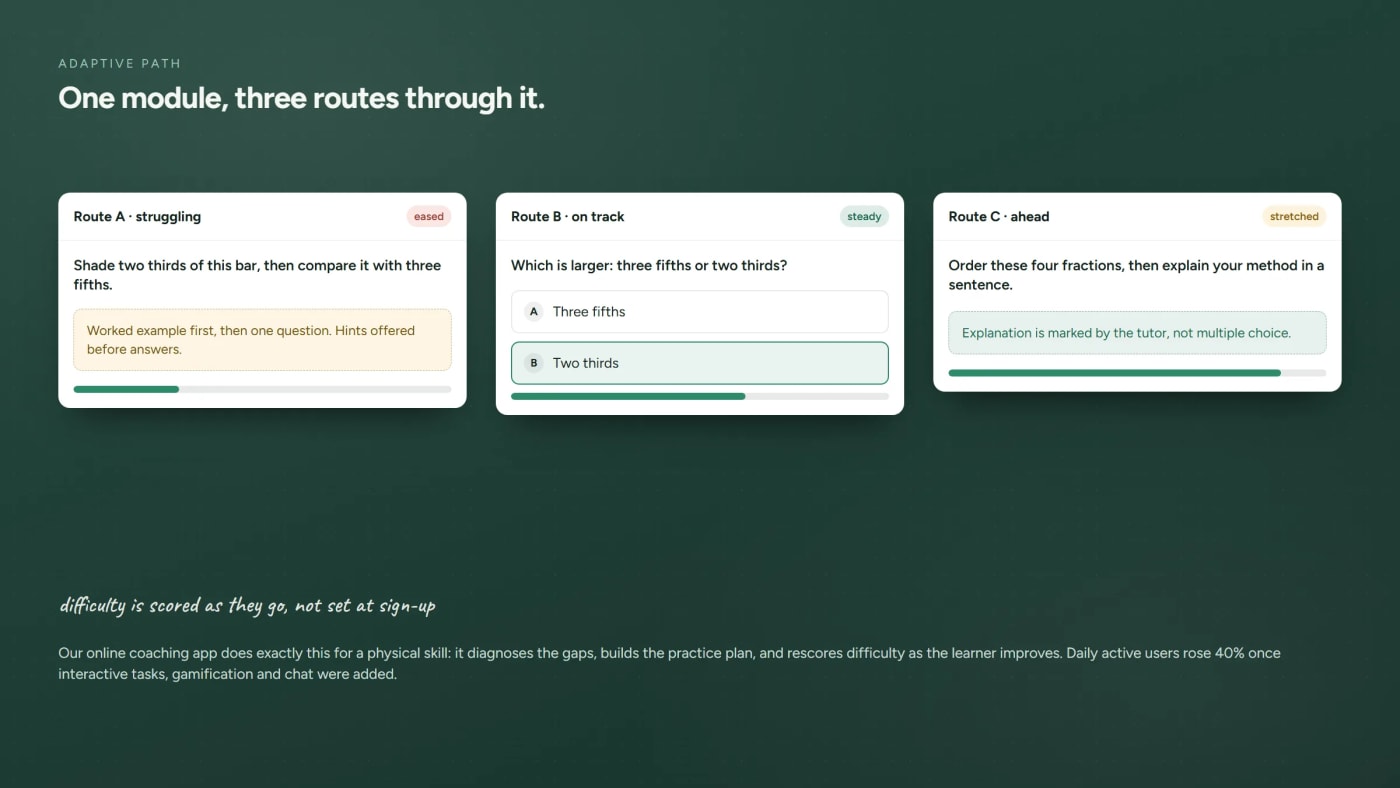
The outcome that mattered to the client was not a test score. It was that learners moved through modules faster with instant feedback, progress became visible to them, and daily active users rose by 40% once interactive tasks, gamification and chat were in place.
Tutoring with guardrails
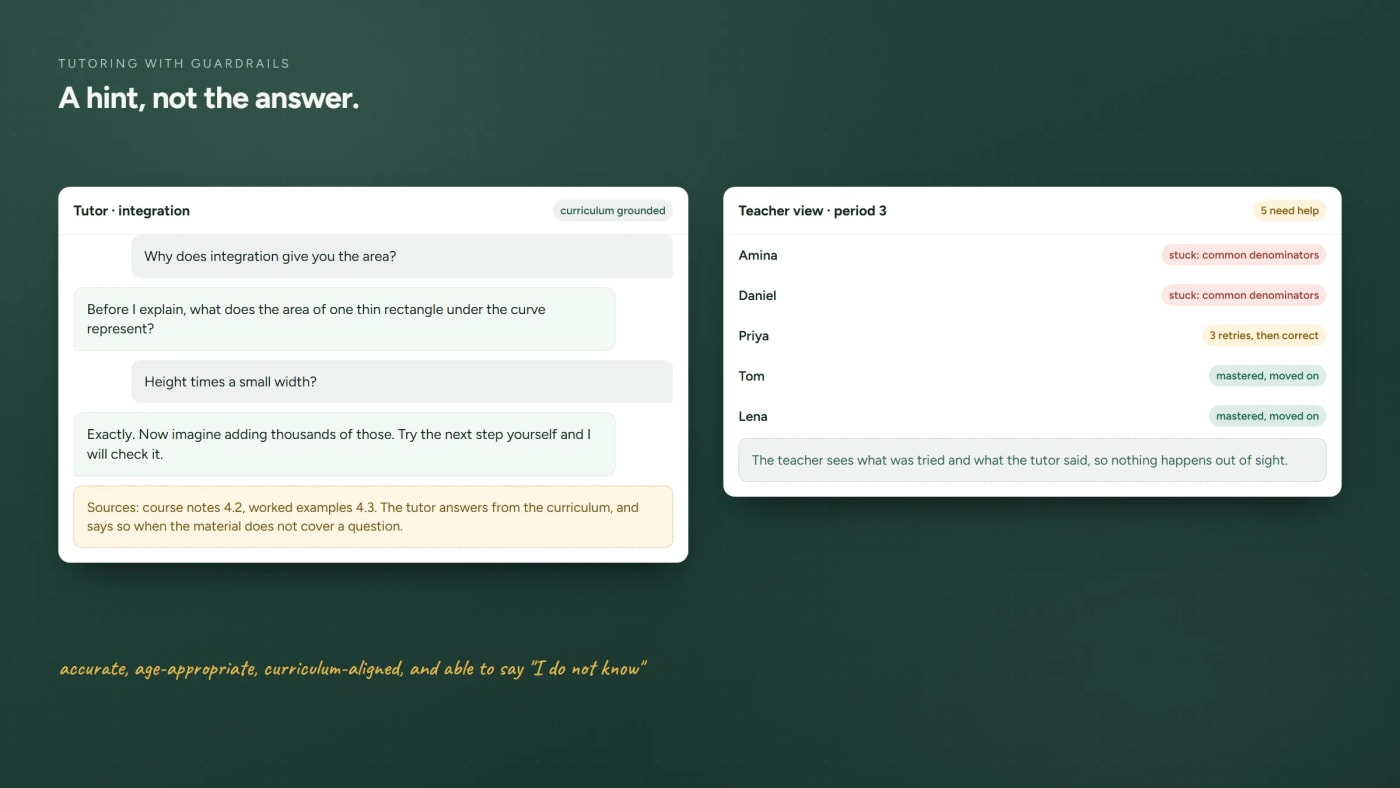
A tutor that invents a formula is worse than no tutor, because the learner has no way to know. Four constraints are not optional: it answers from the curriculum rather than from memory, it suits the age it is talking to, it admits when it does not know, and a teacher can see what it said.
Grounding is the mechanic that makes the first one possible, and it is the same approach we use where accuracy is legally serious. Medd AI drafts with citations and has a second model check them before anything ships, which is exactly the discipline a curriculum-aligned tutor needs. We set out how retrieval works in the piece on RAG.
Assessment that is continuous rather than terminal
The quiz at the end of the module tells you what was forgotten. The useful signal is earlier: which questions took three attempts, which explanation got replayed, where people stopped coming back.
That is an events pipeline before it is a model. Every answer with its latency, every retry, every replay, every abandon, stored in a shape somebody can query without a data engineer. Most education apps skip this, bolt a model on later, and cannot work out why the personalisation feels thin. The model is only as good as the behavioural record underneath it, which is the same lesson we keep running into on the retrieval side of things.
Content that stays current
Generation helps most with the surrounding material rather than the core lesson: practice questions at the right level, summaries, alternative explanations, translations. Our audiobook app does the delivery version of this with AI narration, chapter summaries and adaptive playback speed, so the same material fits a commute or a revision session.
Engagement, honestly
Streaks and badges move numbers, and the numbers they move are not always learning. The version worth building ties the reward to progress through actual difficulty, which is what the coaching app does when the scoring changes as a learner improves.
What the Build Looks Like
- One codebase, three surfaces. The coaching app runs iOS, Android and web from Flutter, which matters because learners switch devices mid-course. The framework trade-off is in our cross-platform comparison.
- A feedback loop measured in seconds. Scoring an answer and choosing the next item has to feel immediate. Anything that waits on a slow model call gets designed around: pre-compute what you can, stream the explanation, never block the next question.
- An events pipeline from day one. Every answer, retry, replay and drop-off, stored in a shape you can query. Without it there is nothing for an adaptive engine to read.
- Privacy that fits the audience. Learner data, and especially data about minors, is regulated and reputationally unforgiving. Collect less, keep processing on the device where the feature allows, as we do with on-device speech in our field-service app, and be able to show what was stored and why.
- More than one language, from the start. The coaching app ships English, German and Spanish. Retrofitting a second language into a learning product means redoing the content model, not just the strings.
How to Build One Without Wasting a Year
- Name the gap, not the category. Not an app for language learning, but the specific thing learners fail at, which is usually speaking rather than vocabulary.
- Pick the AI that matches the subject. Speech work for pronunciation, vision for anything physical or handwritten, retrieval for curriculum answers, and a custom model only where your own data gives you an edge.
- Ship one capability properly. An MVP with genuinely adaptive practice beats a platform with everything half-built. The scoping argument is in our piece on MVPs.
- Measure learning, not just usage. Time to mastery, completion, retry curves and retention after a month. Daily active users is a business metric that can rise while nobody learns anything.
Where This Goes Next
The direction that looks most useful, stated as direction rather than prediction, is multimodal. A learner photographs their handwritten working and the app marks the step where it went wrong. A diagram is read rather than described. A spoken answer is assessed for pronunciation as well as content. A video of a physical attempt gets feedback on the movement.
None of that is speculative technology. We already run vision pipelines of this shape elsewhere: AI-APEX compares progress photographs and adapts the plan from them, and the image diagnosis work we do in other industries is the same pattern pointed at a different subject. What makes it hard in education is not the model. It is having curriculum-aligned ground truth to mark against.
The second direction is quieter and more valuable: the teacher's view. Software that tells a teacher which five students are stuck, on what, and what was already tried, is worth more to a school than a tutor that talks beautifully to one child.
Questions We Get From EdTech Teams
What drives the cost?
Content and integration, not the model. A tutor answering from a curriculum you already own is a contained build. A platform that authors, assesses, reports to teachers and integrates with a school system is several products. Anyone quoting a figure before asking which of those you mean is guessing.
Which models should we use?
Hosted language models for explanation and question generation, speech models where pronunciation matters, and your own small models for the adaptive decisions once you have enough interaction data. Most products end up with a mix rather than one.
Do we need our own AI team?
Not for the first version. You need people who own the pedagogy and the content; the integration can be done with you and handed over. An in-house team makes sense once the adaptive engine is learning from your own data and becomes the product.
How do we keep a tutor accurate?
Ground it in your material, make it cite what it used, have a second pass check the first, and give teachers a view of what it told students. Accuracy is an architecture decision, not a prompt.
What about data on minors?
Decide what you genuinely need before you collect anything, keep the sensitive processing on the device where you can, and make deletion straightforward. Parents and schools ask these questions early, and an answer that sounds improvised costs you the contract.
Start With the Lesson That Loses People
Every course has one. The module where the drop-off happens, the exercise everyone retries, the concept that needs a second explanation nobody wrote. Make the app handle that one properly, with adaptation, a hint before the answer and feedback inside the session, and you will have proved the whole idea on a fraction of the budget.
Not sure which lesson that is? Book a free 30-minute session, and our AI-powered mobile apps page lists what a build includes. Adaptive coaching, audio learning and AI content products are all things we have shipped, and they are the same parts most education platforms are assembled from.
One for the comments: which subject have you tried to learn from an app, and where exactly did it lose you?

Building AI-Powered SaaS Products, Mobile Apps & Business Automation | Trusted by Clients in 20+ Countries
Comments
No comments yet. Be the first to share your thoughts.
Leave a comment