The content problem in most businesses is not writing. It is everything around the writing: finding the topic, gathering the material, keeping the voice consistent, formatting it, filing it, and doing that again next week while the last one is still in review.
A content pipeline is what you build when hiring another writer is not the answer. The model drafts, the automation moves things between steps, and the people spend their time on judgement rather than on blank pages. Here is how one is put together, what each layer is actually for, and what we learned running one.
What a Content Pipeline Is
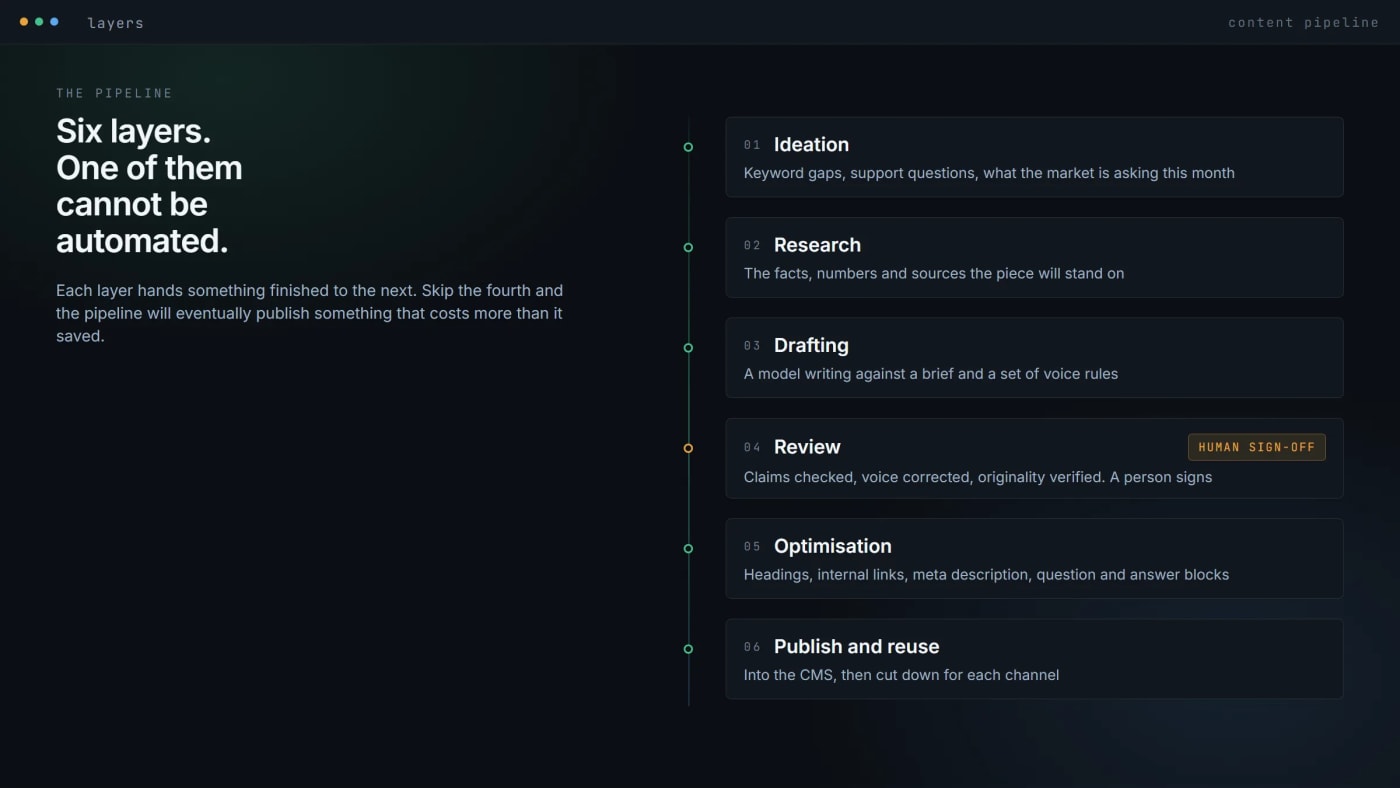
Not an AI writing tool somebody opens when a deadline arrives. A pipeline is a sequence where each step hands something finished to the next one, runs on a trigger or a schedule, and has a defined point where a person signs off.
- Ideation. Where topics come from: keyword gaps, questions customers actually ask, what the market is talking about this month.
- Research. The facts, numbers and sources the piece will stand on, collected before anyone writes.
- Drafting. The model produces a first version against a brief and a set of voice rules.
- Review. A person checks the claims, the tone and the originality. This step is not optional.
- Optimisation. Headings, internal links, meta description, structured data, and the question and answer sections that AI search engines lift from.
- Publishing and reuse. Into the content system, then cut down into the formats each channel needs.
Why This Works Now and Did Not in 2023
Two things changed. Models crossed the line where a draft is a usable starting point rather than something that costs more to fix than to write. And the automation platforms grew up: n8n, Make and Zapier handle model calls, branching, data reshaping and publishing, which is the whole job of a pipeline. We compared the three in a separate piece, with the workflows we run on each.
The economics get quoted a lot and the numbers deserve suspicion. What is true, and what we can see in our own work, is that the expensive hours were never the typing. They were the research, the formatting and the filing, and those are the parts a pipeline takes over. The editing stays, and it should.
The Six Layers, and What Each One Owes You
1. Ideation that is not somebody guessing
Run it on a schedule rather than in a meeting. Keyword gaps from your SEO tool, questions from support tickets and chat logs, competitor coverage, and a model grouping all of it into clusters instead of loose ideas. What lands on the calendar should already be prioritised.
2. Research before drafting, always
The brief is what separates a usable draft from a generic one. Target keyword and secondary terms, the data points that must appear, what the top-ranking pages missed, and the internal material that only you have: case studies, product documentation, numbers from your own systems.
3. Drafting against rules, not vibes
Output quality tracks the brief almost exactly. Define the role, the voice rules, the structure, the keyword requirements, and hand over the research. For specialised subjects a model answering from your own documents will beat a better model answering from memory, which is the case for retrieval rather than fine-tuning, covered in our piece on RAG.
4. Review, which is the one you cannot automate away
Every claim checked against its source, the voice corrected until it sounds like your business, an originality check, and for regulated subjects a specialist who signs it off.
Part of that can be machine assisted. Medd AI drafts medical content with citations written in as it goes, then a second model audits the draft for accuracy, citation format and readability, and a failing draft comes back with an issue log rather than quietly publishing. Where the brief arrives with no sources, Perplexity is sent to find them. The human still signs off, but they start from a draft that has already been argued with.
5. Optimisation that includes being quotable
The familiar work, headings, internal links and a meta description that fits, plus the newer part: clear question and answer sections, because the systems summarising the web lift those directly. Keyword density checks automate well. Choosing which internal links matter does not.
6. Publishing and reuse
The last mile is formatting and delivery, and it is where automation saves the most tedium: into the content system, cut down into the posts each channel wants, a paragraph pulled for the newsletter, and a message to whoever needs to know it went out.
What Ours Actually Does
Our own content generation pipeline solves the narrower version of this problem, and it is worth describing exactly because the real thing is always less magical than the diagram.
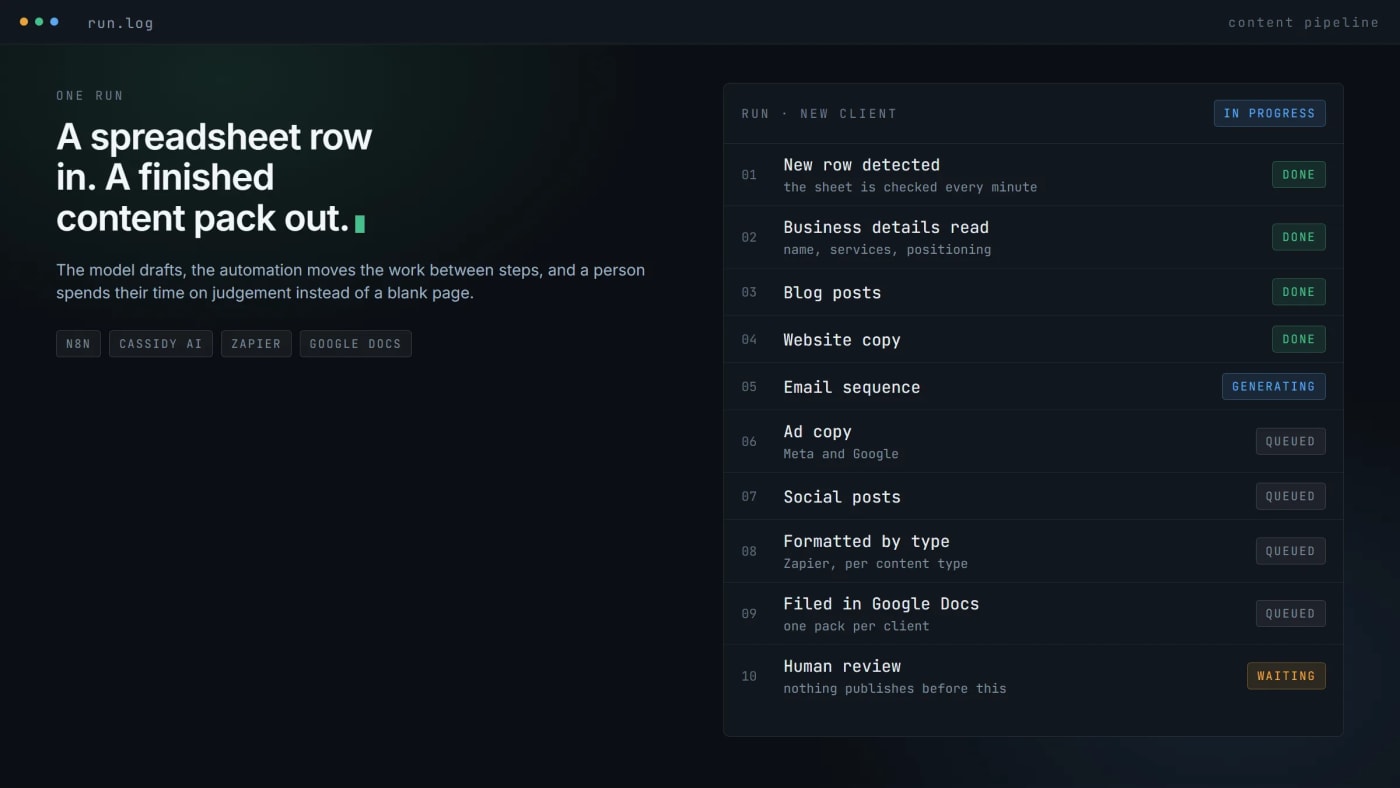
A marketing agency used to write every new client's content pack from scratch: blog posts, website copy, email sequences, ad copy, social posts. Days per client, and the formatting came out different every time.
- The trigger is a spreadsheet row. The sheet is checked every minute, so adding a client starts the run with nobody pressing anything.
- The run has an order. n8n reads the business details, then Cassidy AI produces blogs first, then website copy, then emails, then Meta and Google ad copy, then social posts.
- Formatting is a step, not an afterthought. Zapier formats each piece by type and files it in Google Docs, so every client's pack looks the same.
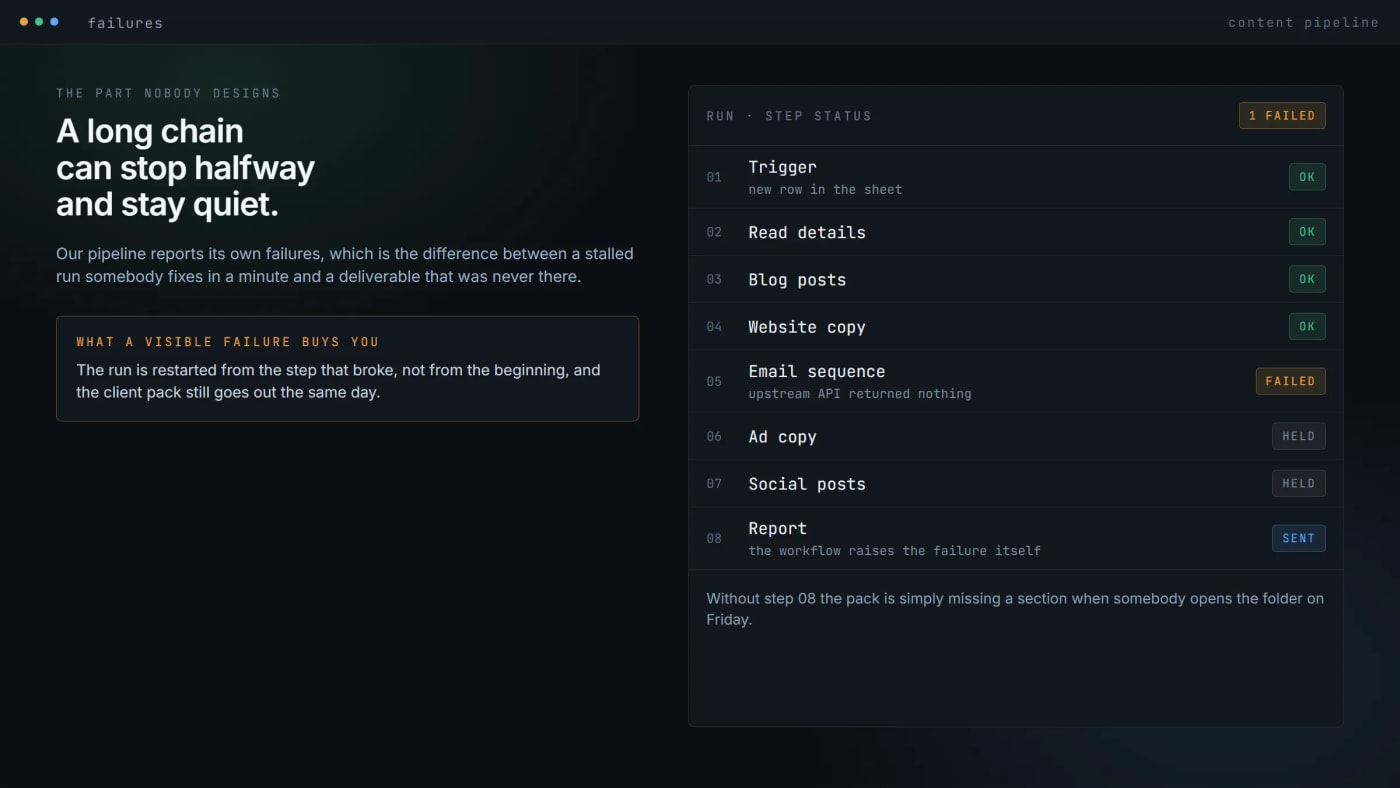
- Failures are visible. A long chain can stop halfway and nobody notices. The workflow reports its own failures, which is the difference between a stalled run and a missing deliverable.
The outcome is not that nobody writes any more. It is that paid time goes on editing rather than on starting from nothing, and that delivery stopped being a manual job.
Choosing the Pieces
- The automation layer. n8n when the workflow needs real logic or has to run on hardware you control, Make when a non-developer owns it day to day, Zapier when the job is wiring standard tools together neatly. We use all three, on different builds.
- The models. Different jobs suit different models, which is why GoAI Chat scores each request and picks the model and agent most likely to handle it. A pipeline can do the same: a strong model for the long draft, a cheaper one for summaries and social cuts.
- The supporting tools. Keyword research, an originality check, your content system's API, and a scheduler. None of these are the interesting part and all of them have to work.
Four Ways These Go Wrong
- Publishing without a person. Sooner or later the model states something confidently wrong, and it goes out with your name on it.
- Prompts with no brief behind them. Write a post about AI produces exactly what you would expect. The specifics are what make the output sound like it came from your business.
- A pipeline with no strategy. Volume without a reason is noise. Every piece should target a question somebody is actually asking.
- Posting the same text everywhere. Reusing a long piece across channels is sensible. Pasting it unchanged into all of them is not.
What People Ask Before Building One
What does a pipeline cost to run?
Two parts. Building it, which is driven by how many systems it touches and how much review it has to route through, and running it, which is model usage plus whatever tools you already pay for. The ranges published online are guesses about somebody else's setup. Price yours by counting the integrations, not the articles.
Can this content rank?
Google's position is that it rewards quality however the content was produced, and that using automation mainly to game rankings is spam. Its guidance on AI-generated content is worth reading in the original. Since then the quality rater guidelines have taken a harder line on pages whose main content is low effort and automated, which is the same conclusion from the other direction: the pipeline is fine, the slop is not.
Which content types suit a pipeline?
Anything with a repeatable shape: product descriptions, FAQ pages, email sequences, ad variants, social cuts, and the explanatory half of blog content. Opinion, original research and anything that depends on having been there belong to a person, with the model helping around the edges.
How do we keep the brand voice?
Put the rules in the brief every time: what you sound like, the words you avoid, sentence length, and examples of approved phrasing. If that is not enough, point the model at your published work through retrieval so it writes with your own material in front of it.
Will readers be able to tell?
They can tell when a piece has nothing specific in it. The fix is not a clever prompt, it is substance: real numbers, named systems, things that actually happened. Our own rule is that a claim either comes from our work or it does not go in.
Build the Narrow One First
Pick the piece of content your team produces most often and automate that one path end to end, including the review step and the failure reporting. A pipeline that reliably produces one kind of thing is worth more than a diagram covering seven channels that nobody trusts yet. More on scoping that kind of build is in how we scope an agent build.
If you want help mapping yours, we run a free 30-minute consultation, and the AI automation and AI agents page covers what a build involves. Since 2020 we have shipped this kind of automation for agencies, clinics and software teams, with an Upwork feedback average of 4.99.
One for the comments: which part of your content process eats the most time, the research, the writing or the formatting?

Building AI-Powered SaaS Products, Mobile Apps & Business Automation | Trusted by Clients in 20+ Countries

Comments
No comments yet. Be the first to share your thoughts.
Leave a comment